Knitting the Bead Stars in the Mini Flag

Behind the Design Scene of the Mini Lace and Beaded Flag

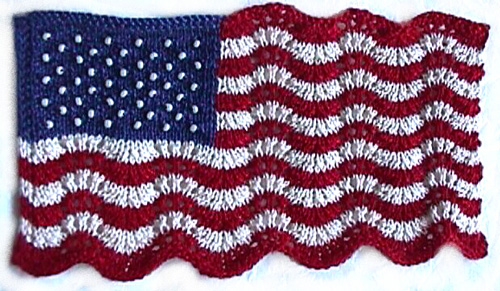
The knitted miniature representation of the U.S. Flag for this month’s project features an attractive use of beads.

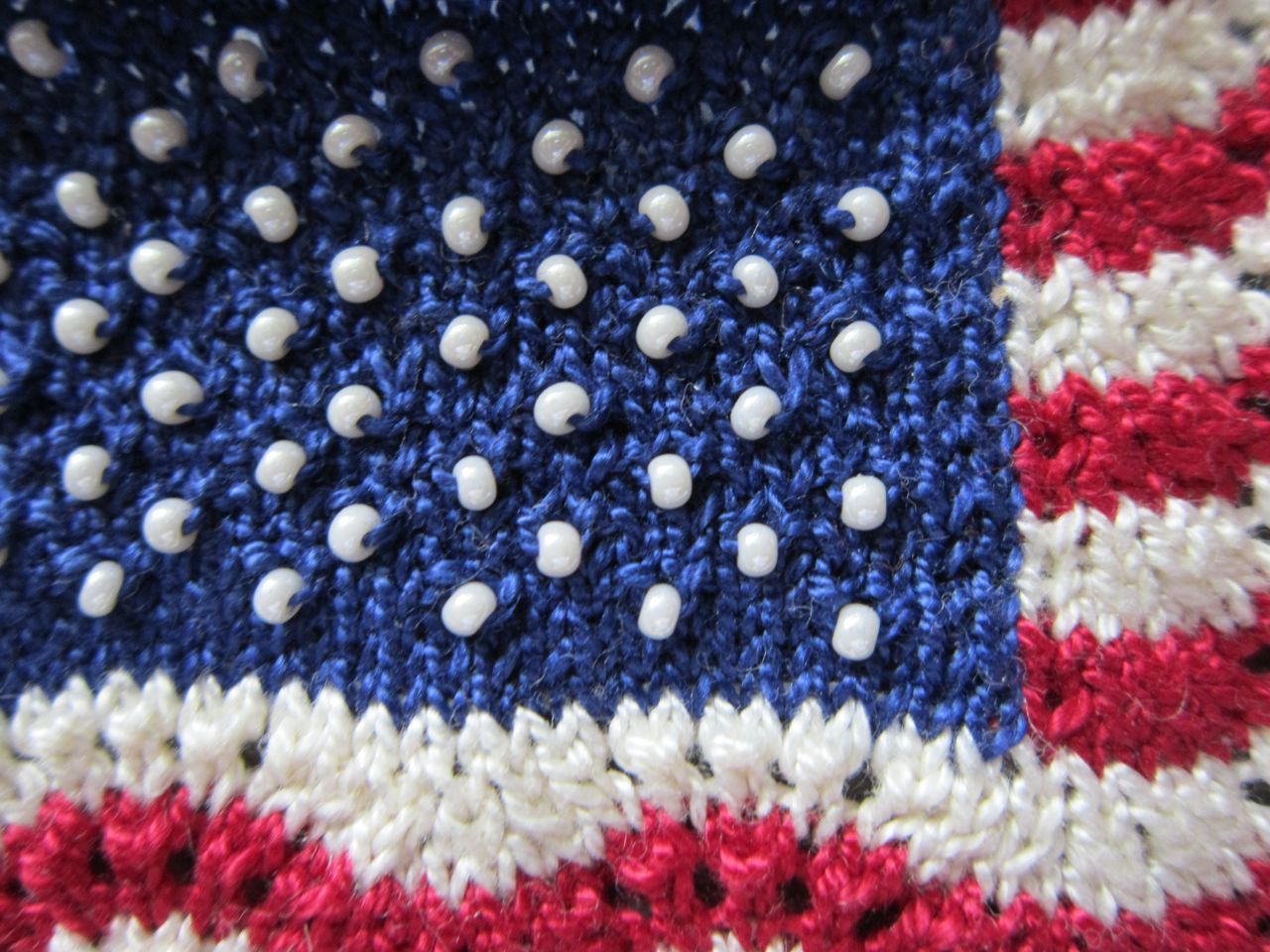
Bead stars in the miniature knitted representation of the U.S. flagThe beading method used for the Mini Flag project positions a tiny bead on the running thread between 2 stitches.

The Beading Truth

Beads want to go to the bumpy side of the fabric (and will do so unless something is holding them back).

To keep the beads facing to the right side of the primarily stockinette fabric, this design places beads on right side rows differently than wrong side rows. Continue reading

Posted in Bits of Beads | Tagged , | Leave a comment

Tips for Stringing Tiny Loose Beads

There are specialty beading needles available for stringing tiny loose beads 10/0 (approx 2 mm) and smaller. Twisted wire and split eye are popular ones. But frankly, I usually just use the low-tech alternative of a small sewing needle with sewing thread eye because I don’t seem to lose this as easily as the others. (I use a brightly-colored sewing thread for the thread eye loop just to make sure, lol.)

How you get loose beads strung onto your thread is a personal choice. Practice makes things go faster, so be patient and just experiment with what works best for you. Here are some ways you might try —  Continue reading

Posted in Tips & Techniques | Tagged , , , , , | 1 Comment

String 50 Beads for the Mini US Flag Stars

Prior to starting the blue union area (row 26) of the Mini US Flag, string 50 tiny beads onto your blue thread. 50 beads are needed because each bead will represent a “star” in the flag. As you knit, you will push the beads along the thread until you need them.

For this mini flag project, the beads are pre-strung on your working thread because we will be using the beading technique that places a tiny bead between stitches (rather than a larger bead on a stitch as in the Yarn Pouch project we did last month).  Continue reading

Posted in Bits of Beads | Tagged , | Leave a comment

Tips for Changing Colors in the Mini Flag

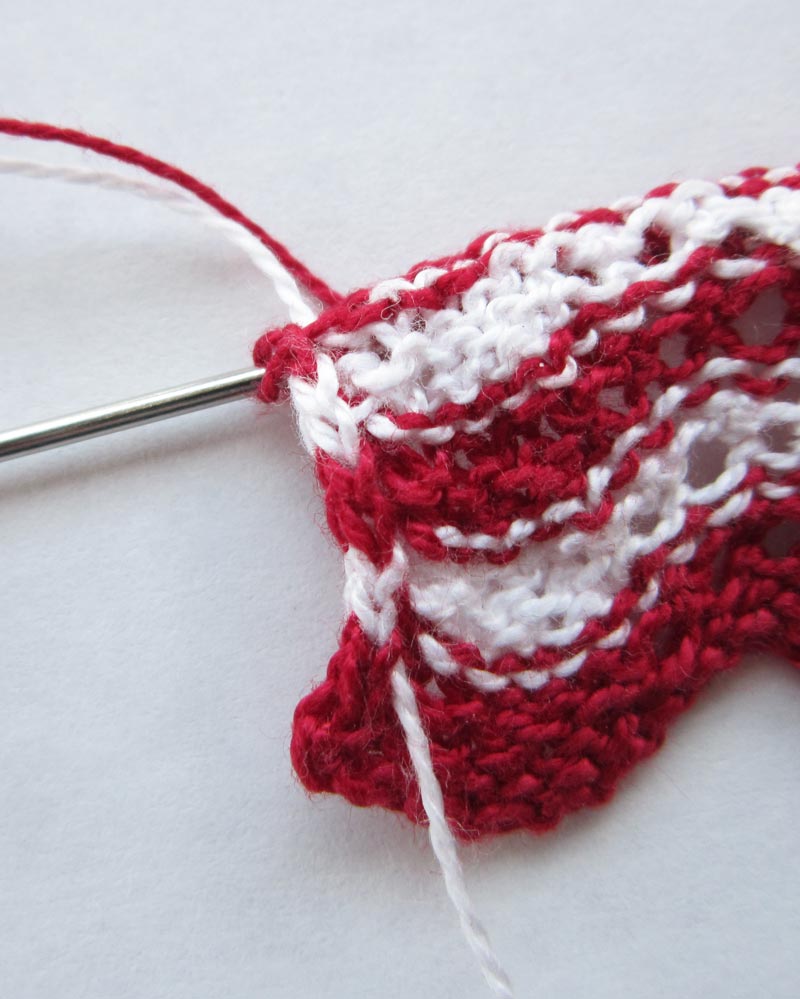
Even though you will need to change colors when making the Mini Flag, do not cut your thread between color changes. There is no need to create extra ends that will add bulk to the fabric and require additional project time for weaving. Here are tips for changing colors and avoiding long carries between stripes by hiding the unused yarn color within the narrow tubular edge.

WS view of the narrow tubular edge along the end of the row where yarn colors change

WS view of the narrow tubular edge along the end of the row where yarn colors change

Tip 1 — When changing colors: pick up new color from beneath the old color. As you begin to knit the next stitch, snug up the tension slightly to avoid looseness. After knitting the stitch above the stitch where you left off in the old color, gently tug on the end of the old color to “lock” the threads into place.

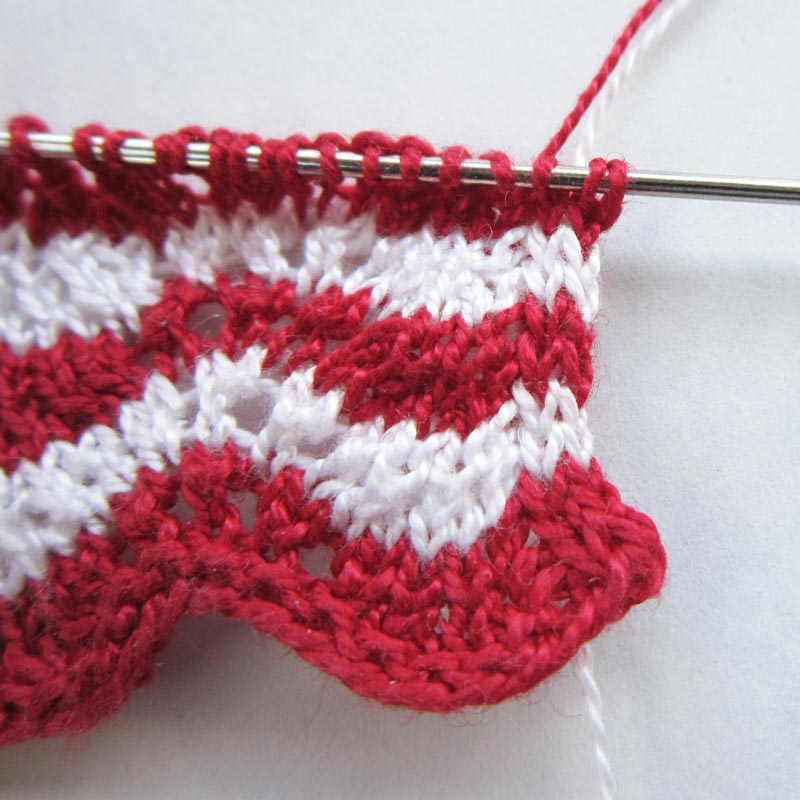
Tip 2 — To avoid long carries between stripes when changing colors, twist the thread not being used around the thread being used on the middle RS rows of each white and red stripe beginning with the first white stripe, and ending on the last white stripe. To make as inconspicuous as possible from the RS, I suggest this (I will use row 8 as the example):

k3 (i.e. in white for this example row),

pick up color not being used (i.e. red in this example) from beneath the white, to the right, then over the top and to the left, thus encircling the white thread with the red,

k1 (in white),

then gently tighten the tension on the red thread to the right toward the tubular edging so as to “lock” the threads into place and hide the red from showing on the RS.

RS view of the narrow tubular edge along the end of the row where yarn colors change

RS view of the narrow tubular edge along the end of the row where yarn colors change

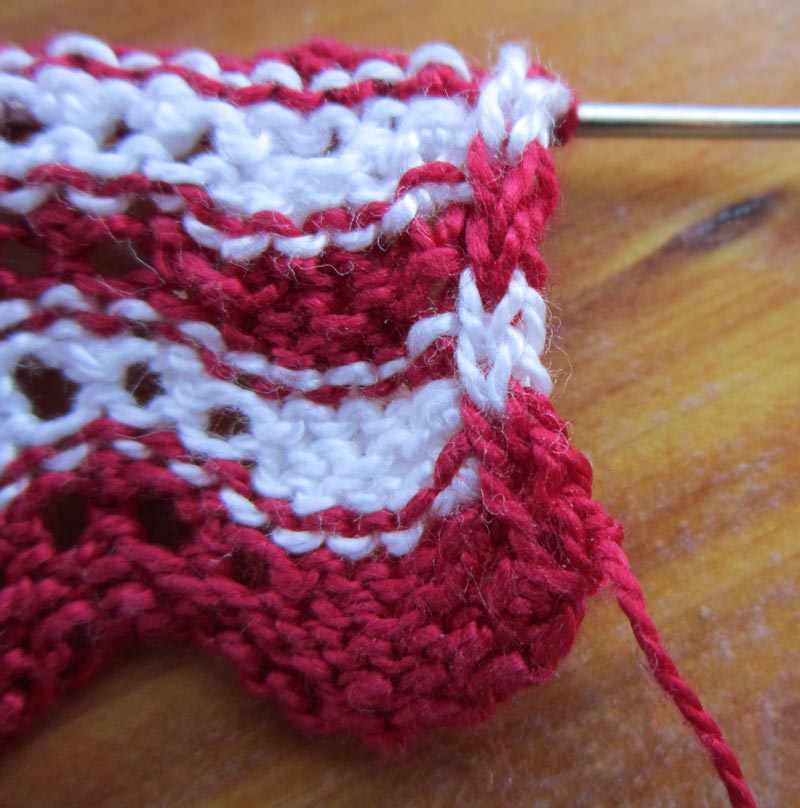
Design Note — Even though there are no color changes along the other end of the row, that edge is also worked tubularly so that both side edges have the same rounded look and similar stability.

WS view of the narrow tubular edge along the opposite end of the row

WS view of the narrow tubular edge along the opposite end of the row

Posted in Tips & Techniques | Tagged , , | 3 Comments

Knitting Lacy Stripes for the Mini Flag

Behind the Design Scene of the Mini Lace and Beaded Flag

The Mini Flag we are knitting for April’s KAL is loaded with interesting techniques and details. On a quick look, some are obvious and others might not be.

Natural Bias

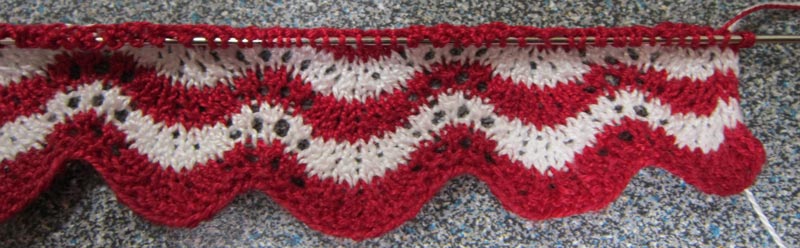
The Mini Flag starts with 4-row stripes of red and white. The natural bias of the lace stitch pattern gives the feeling of a flag waving in the breeze.
Beginning the Mini Flag

The stitch is one of the simple variations from the family of Shetland lace patterns referred to as Old Shale (sometimes also called Feather and Fan).

The characteristic bias/waviness is caused by the grouping of yarn overs that are separated from their compensating decreases.
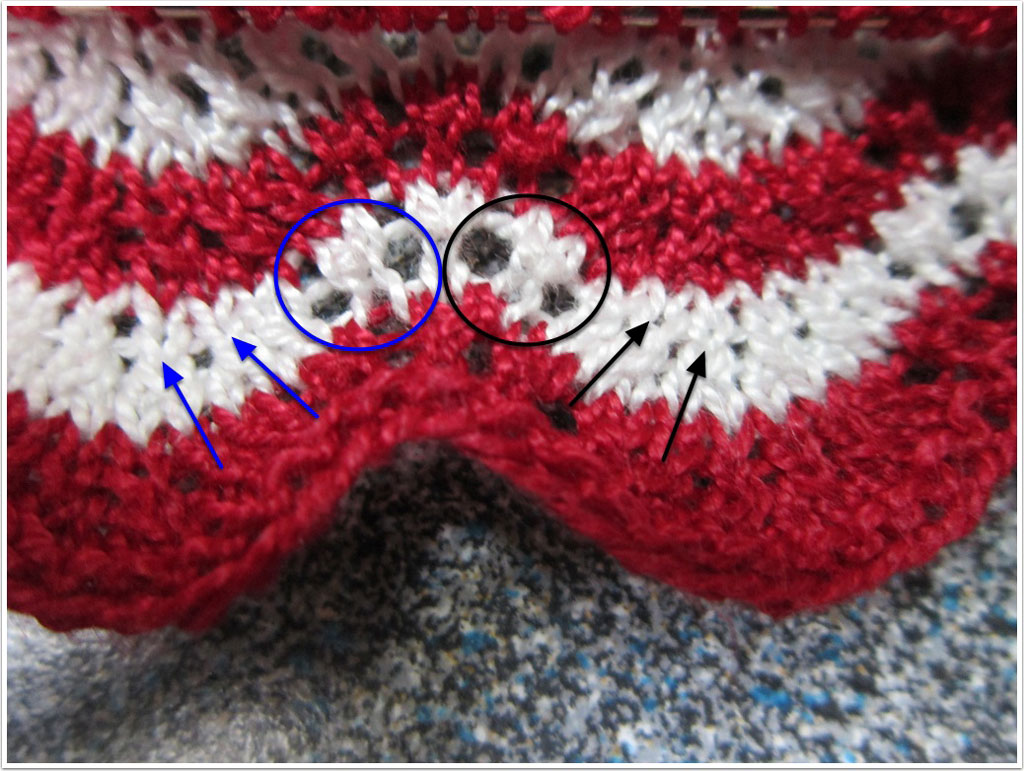
Separation of yarn overs and compensating decreases causes natural bias

The 2 right-leaning decreases (indicated by black arrows) to the right of the 2 yarn overs within the black circle cause the fabric to bias upwards to the left.

The 2 left-leaning decreases (indicated by blue arrows) to the left of the 2 yarn overs within the blue circle cause the fabric to bias upwards to the right.

Tips for a Cast On Edge that Won’t Curl Later On

It is important to cast on loosely enough so that the cast on edge will not cup later on. Remember that the important aspect of a loose cast on is the distance between the cast on stitches.

Even so, since the stitch pattern of the red and white stripes is stockinette-based, the cast on edge will want to curl unless we take an additional step. To help fight that tendency, the first row is knit from the WS, thus producing a reverse stockinette ridge along the bottom edge of the flag. This by itself won’t totally eliminate curling, but together with blocking later, will result in a non-curling edge provided you have cast on loosely enough.

Tubular Side Edges

The 3 slipped stitches at beginning and end of the WS odd-numbered rows create a rounded tubular edging. Follow the instructions exactly to slip these stitches purlwise with yarn in front so that the gap between 1st and 4th stitch is pulled together on the WS.

Note: Do not be concerned that it takes several rows before the 3 slipped stitches start to look neatly rounded along the edge.

This tubular edge technique will help stabilize the side edges of the flag and keep them from curling.

You’ll also also see later on how the tubular technique will give a place to hide the unused thread color between color changes.

First Color Change

Up through row 5, you are working with red thread only. When beginning row 6, you are ready to begin using white.

Just drop the red thread. DO NOT CUT.

To begin row 6 with white thread, I just leave a tail and start knitting. There is really no need to otherwise temporarily “attach” the white thread unless it just makes you feel more comfortable.

Next up: Tips for changing colors and avoiding long carries between stripes in the Mini Flag.

Posted in Bit-size Tutorials | Tagged , , | 1 Comment

April Prize Giveaway

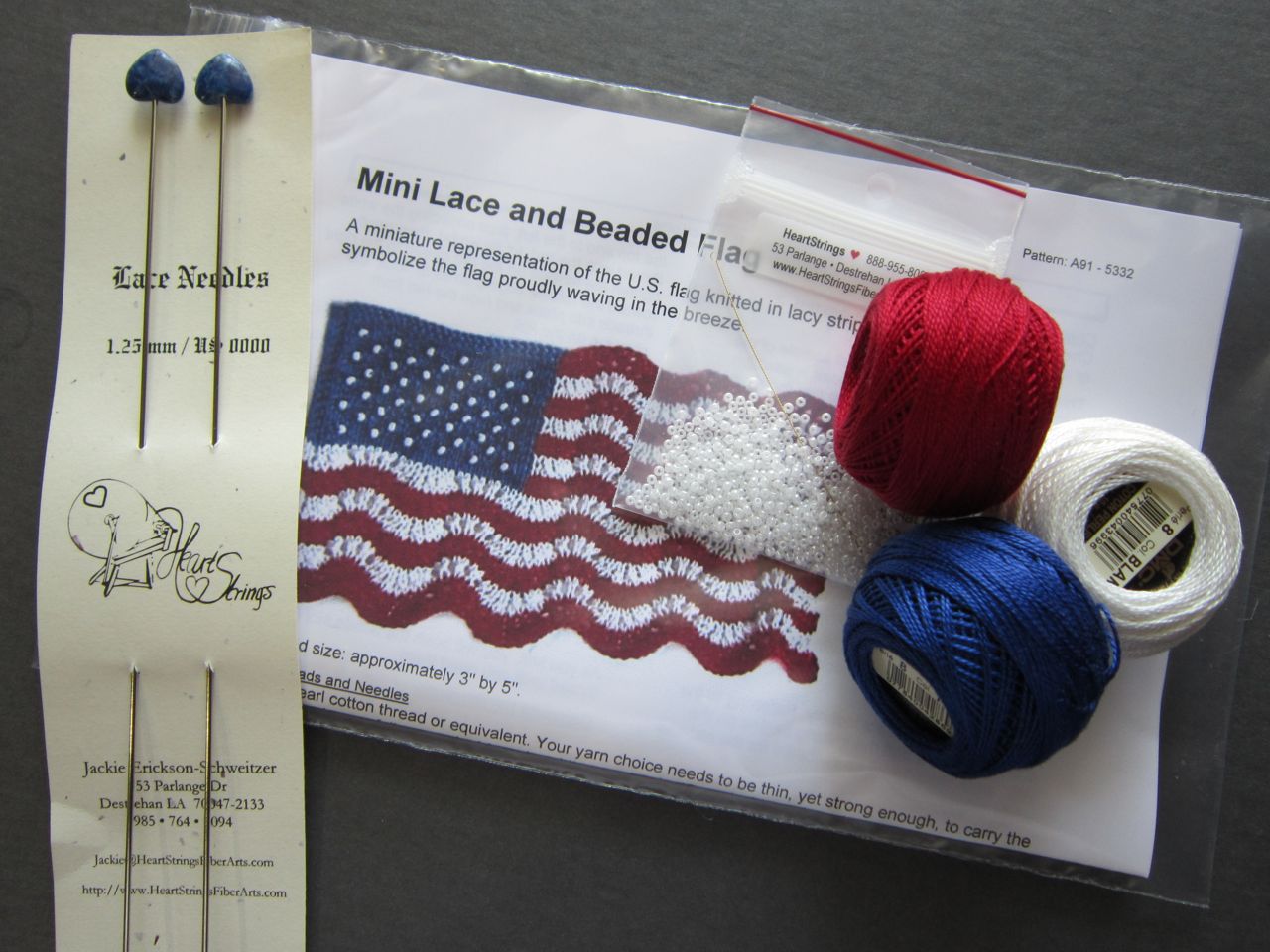
Win a complete kit with all the materials to make several Mini Lace and Beaded Flags AND a beautiful set of coordinating lace knitting needles with blue lapis gemstone heart end caps. The Prize Package to be given to a lucky winner at the end of April 2013 contains:

Mini Lace and Beaded Flag Kit with Gemstone Heart Lace Knitting Needles

April Prize Drawing – Mini Lace and Beaded Flag Kit with Gemstone Heart Lace Knitting Needles

1) One full 10g ball each of red, white and blue DMC size 8 perle cotton thread

2) Miyuki size 11/0 Pearl White Ceylon glass seed beads

3) Collapsing eye twisted wire beading needle

4) Coordinating blue lapis gemstone heart lace knitting needles in size 4/0 US (1.25 mm)

5) Autographed pattern

To enter the drawing, purchase anything from the KnitHeartStrings Store during April 2013. (if you have already bought something earlier this month of April, it will count)

If you are a Premium Level member, you automatically get an entry. Purchase anything from the KnitHeartStrings Store during April 2013 and you get an additional entry. 2 chances to win!

The random drawing  will be held on May 1, 2013 and announced shortly afterwards. Winner will be contacted by email for shipping address. Good luck to everyone!

p.s. Due to an emergency, I am not able to ship tangible items like kits and supplies paks until the week of April 22. Of course, you are still able to download any e-Patterns immediately after payment.

Posted in Just for Fun | Tagged , , , | 3 Comments

Check Your Thread Colors for Colorfastness

For the Mini Lace and Beaded Flag, it is particularly important to check that your thread colors are colorfast. If not, or in doubt, pre-wash before using.

Mini Lace and Beaded Flag

Mini Lace and Beaded Flag

You certainly don’t want a disaster later if the red or blue dyes run into the white (which would be very obvious), or even the blue dye running into the red (probably somewhat less obvious, but would look weird).

Checking for colorfastness is easy to do by taking a small sample of the thread, say 18 – 20 inches. Let it soak in warmish water for 15 – 30 minutes (this is so that moisture is completely taken up into the fiber). Then lay out on a white paper towel until dry. If your towel shows any sign of colors, then wash the yarn before using.

If you need to pre-wash, wind a small skein with the thread and secure loosely with temporary ties in 3 or 4 places around the skein. Put each color that is to be washed in a separate container of warm water with a bit of detergent. Let soak for at least 30 minutes, then rinse in clear water. If color still runs, consider using another thread.

I did not have any bleeding with the DMC pearl cotton thread I used, but I’d still check just to make sure. Then you can knit in confidence rather than have a nagging worry about might happen later on. A few minutes could help you avoid a disaster!

Posted in Tips & Techniques | Tagged | Leave a comment