Bead Fringe Loops

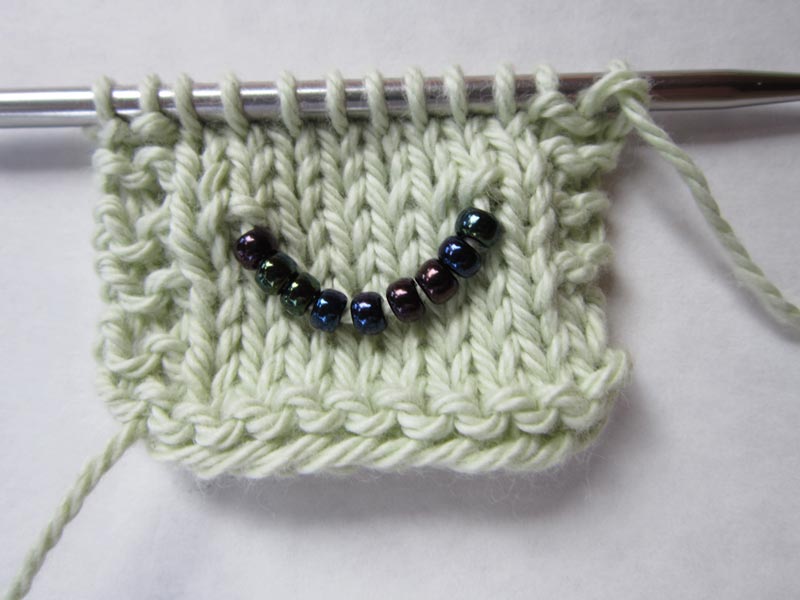
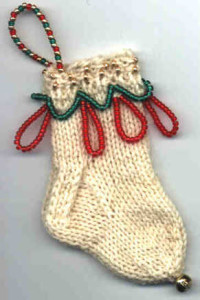
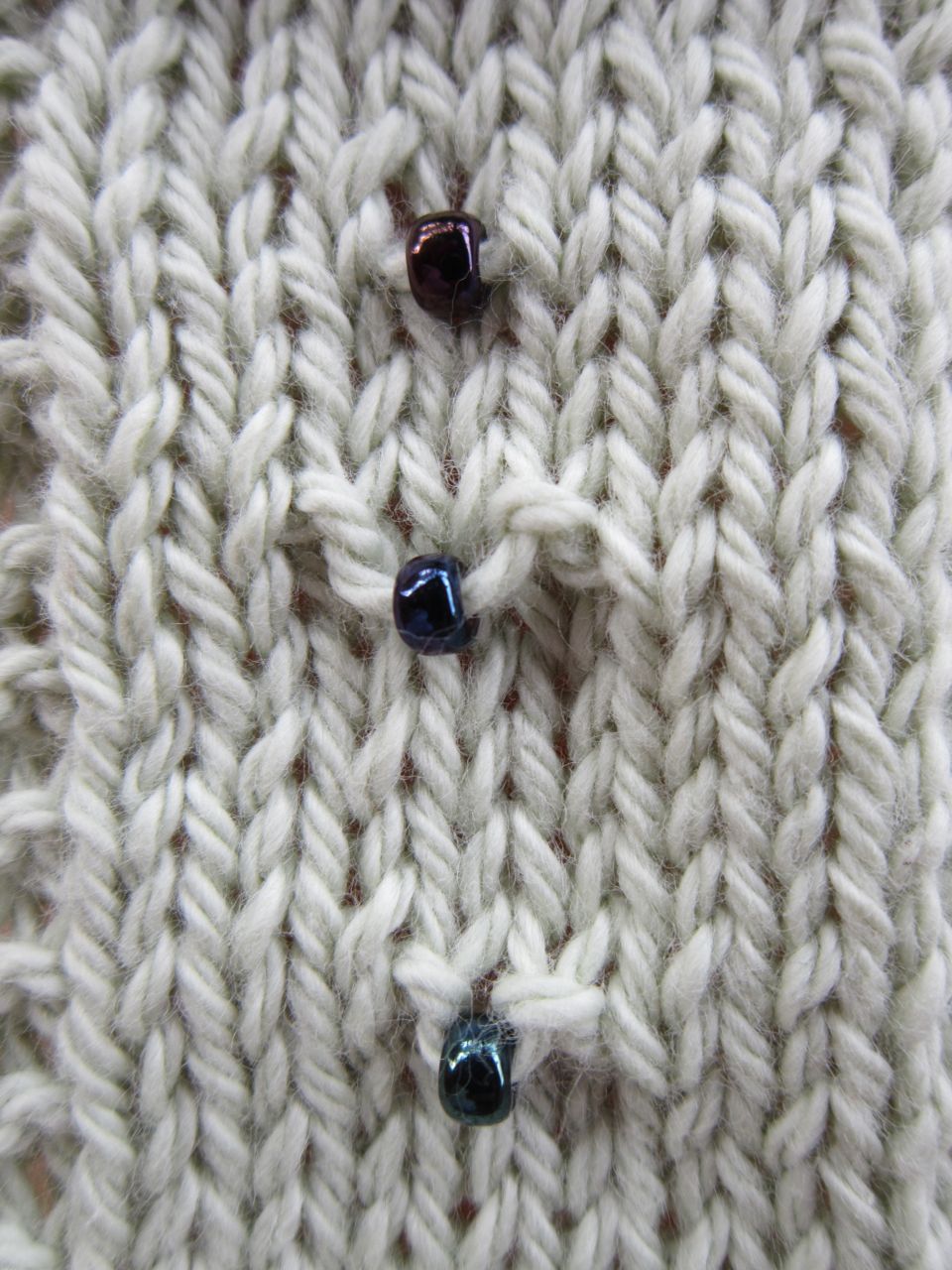
The 3rd of the 3 beaded knitting techniques used in the Holiday Beaded Mini Sock is for creating bead fringe, a closed loop of beads. In the design of the Bells on My Toes mini sock, there is a loop of red beads positioned beneath each point where a swag of green beads attaches to the sock leg.
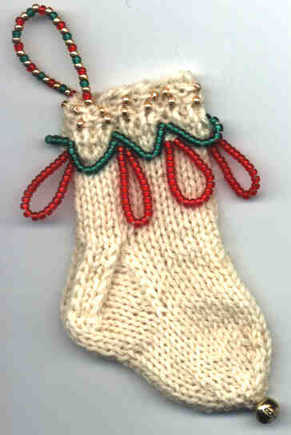
holiday minisock

Important Note: Since we are knitting this sock top-down from cuff to toe, the loops of beads are knit after the swags. Therefore while knitting this top-down sock leg, the loops of red beads will appear to be oriented above the swags of green beads.

To create a Bead Fringe Loop
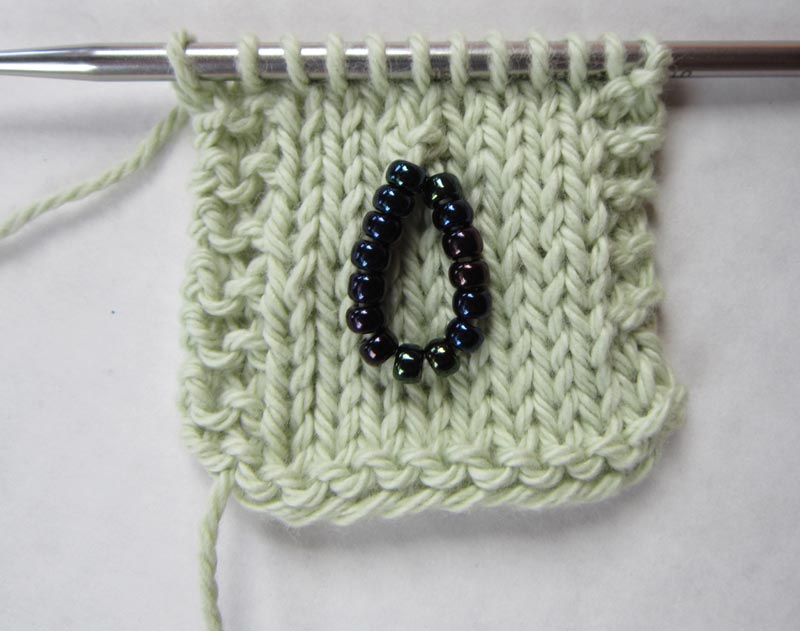
bead fringe loop

Prerequisite. However many beads needed for the fringe loop(s) should have previously been strung on the working yarn.

Note: 2 rows are required to complete a bead fringe loop.

1st Row —

Step a: p1 but DO NOT remove stitch from left hand needle yet.

Step b: Slide several beads along the working yarn so that they are scooted up close together, with the first bead right next to the p1 stitch that you made in Step a.

Step c: k into the back of the same stitch that you purled into and discard the stitch from the left hand needle.

Step c increases a stitch for each fringe loop you have create in the row. For the Holiday Beaded Mini Sock, we create 6 bead fringe loops, therefore the stitches in the row increase from 24 to 30.

2nd Row —

p2tog the p1 stitch and the k into back of stitch of the 1st row.

This p2tog step restores the stitch count to the original number (i.e. 24 stitches in the case of the Holiday Beaded Mini Sock).

Note that the p2tog “locks in” the top of each beaded fringe loop, thus making it look tidy.

Tip: Before completing the p2tog, be careful that the beads have not slipped to the back of the work. If so, coax them to the front again, and then p2tog.

Remember that since we are working the mini sock from cuff down, the bead fringe loop will actually hang in the opposite direction from that when we are knitting it.
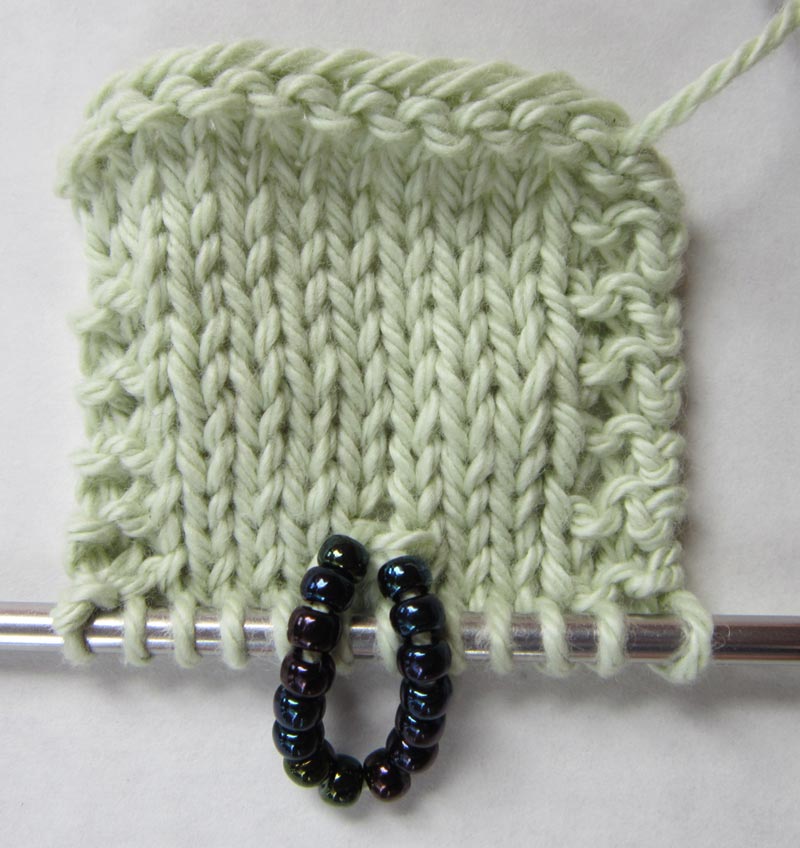
bead fringe loop oriented for top-down knitting

Although we might usually think of “fringe” as being at the edge of something, I have used this technique within the leg of the Bells on Your Toes mini sock for decorative effect. Remember the approach used here in Rnds 9 and 10 of this mini sock pattern for the next time you may want to do a beaded fringe on a scarf, shawl, etc. You can adjust the spacing of the k stitches and the number of beads as you wish.

Happy Christmas in July!
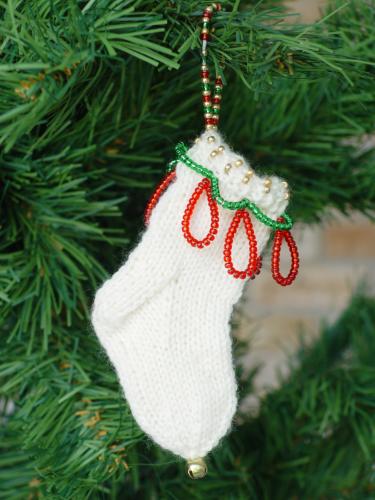
Bells On My Toes Holiday Beaded Mini Sock

Bells On My Toes Holiday Beaded Mini Sock

I hope you have found your beaded knitting experience to be fun and rewarding, and that you are inspired to do even more beaded knitting.

Remember that if you have questions or comments, you can post here.

Member Gallery

I invite you to upload photos your Beaded Holiday Mini Sock or and any other inspired variations for display in the KnitHeartStrings Member Gallery. Thank you for sharing.

Posted in Tips & Techniques | Tagged , | Leave a comment

Kicking off August Knit-Along: Kitty In Your Lap Towel

Perfect for the most avid kitty lovers:
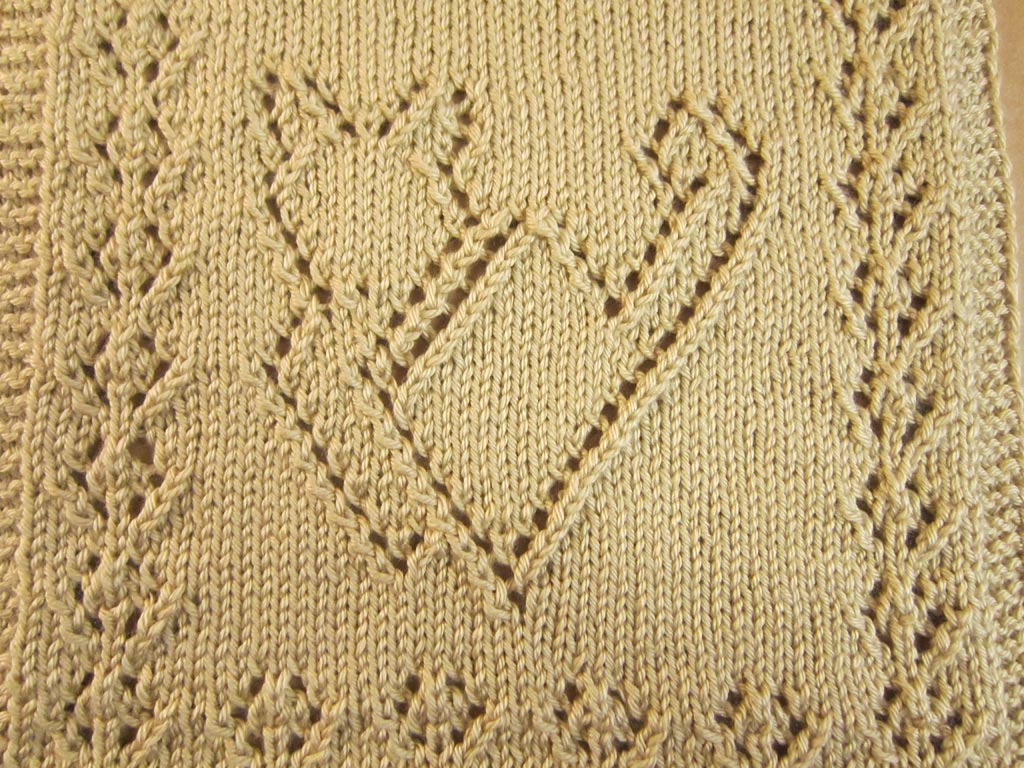
this knitted lap cloth or hand towel features a cute lace cat motif.

For August’s KAL, we are back to doing lace. But since the project is knitted with heavy worsted weight yarn, we are going to prove that not all lace needs to be knit on tiny needles with teensy yarn.

Crafty knitters, spinners and crocheters all know the value of using a towel in your lap to provide protection from stray fibers as well as give contrast/lighting for better visibility of stitches or drafting zone.

Now here’s your chance to knit your own lap towel that features a friendly feline friend. Kitty In Your Lap Towel is the August KAL here at KnitHeartStrings.

Kitty In Your Lap Towel

The friendly feline friend of Kitty In Your Lap Towel

Shopping List

  • Heavy worsted weight or Aran weight yarn:215 yards for rectangular towel with finished measurements 13″ x 22″. Note: You can also do a square 13″ x 13″ lap cloth version with approximately 125 yards if you are looking for quicker project or have limited amount of yarn.
  • Knitting needles size 8 (5 mm) suggested for gauge of 17.5 sts and 6 rows = 4″.  Note: Gauge is not critical although could affect planned yardage given above. The kitty motif is knitted near the beginning of the towel, so once you get past that, you could easily adjust the length if you find yourself running short of yarn.

I used Caron Simply Soft, a 100% acrylic yarn for the pictured sample model, color Bone #9703. It comes in a large 6 ounce skein of 315 yards, so 1 skein will be plenty enough if you need to purchase rather than being able to find something in your stash that will work. (Which was my case, since I am still on my summer travels! I must admit that I am starting to get homesick for my stash, among other things, lol.)

Pattern

I will post Kitty In Your Lap Towel pattern in a couple of days. When available, the pattern will be free to KnitHeartStrings.com members during August. Meantime, I wanted to give you a heads up so you can get your yarn and needles ready to knit!

Be sure to let your knitting friends know that they can join KnitHeartStrings for free and get  a free pattern, too. Thank you for sharing and spreading the word.

Posted in Bits of Lace | Tagged , , , | 3 Comments

Swags of Beads

The 2nd of the 3 beading methods used in the Holiday Beaded Mini Sock is for creating a swag of beads.

A “swag” is what you might do with holiday garland when you fasten it at each end and let it hang down a bit in the middle.

Holiday Garland Swag

To create a swag with beads

Prerequisite. However many beads needed for the swag(s) need to have previously been strung on the working yarn.

Step 1. Begin the swag with a p1 stitch.

Step 2. Slip 2 or more stitches while still keeping the yarn to front of work.

Step 3. Slide several beads along the working yarn so that they are scooted up close together, with the first bead right next to the p1 stitch that you made in Step 1.

Tip: When designing your own swags,  you can use however many beads will give a pleasing shape to the swag. 3 to 4 times the number of beads as you have slipped stitches is probably a good guideline. Fewer beads will make the swag shallower. More beads will make the swag hang down more in the middle.

Step 4. End the swag with a p1 stitch. Take care that no beads are pulled through the p1 stitch AND tension the yarn so that no extra space is left between the beads (or at least as little as possible).

Tip: Depending on the yarn you are using, it might still want to stretch out a bit with the weight of the beads, so draw up the tension if needed on the yarn a bit extra as you make the p1 stitch in Step 4.

Sample swatch with a swag of beads

Comparing Methods

When you think about it, a swag of beads is really just an extension of the method for place a single bead in front of slipped stitch we covered previously. As a reminder, we used the single-bead-in-front-of-a-slipped-stitch-method for the gold beads in the cuff of the holiday mini sock.

a. Instead of a single slipped stitch, the swag method has more than one slipped stitch.
b. Instead of a single bead, the swag method has several.

Continuous Swags of Beads

The green beads in the Bells on My Toes mini sock were designed to simulate the look of a holiday garland of greenery. Instead of a single swag, the swags encircle the upper leg of the sock.

holiday minisock

To make the swags of beads continuous, the p1 stitch that ends a swag in the above steps is the same p1 stitch that begins the next swag.

This is how the instructions for the round of continuous swags is worded in the holiday mini sock pattern —

Rnd 7 (swags): (p1, sl 1 wyif 3 times, sl 12 green beads) 6 times.

Note that Rnd 7 uses up exactly all of the green beads.

As usual, check your work before proceeding, as it is easier to correct any miscounting of stitches or beads now rather than later.

Other Ideas for Embellishing with Swags of Beads

Swags of beads can be used to embellish just about anything. Do consider the additional amount of weight they will add in a relatively concentrated area.

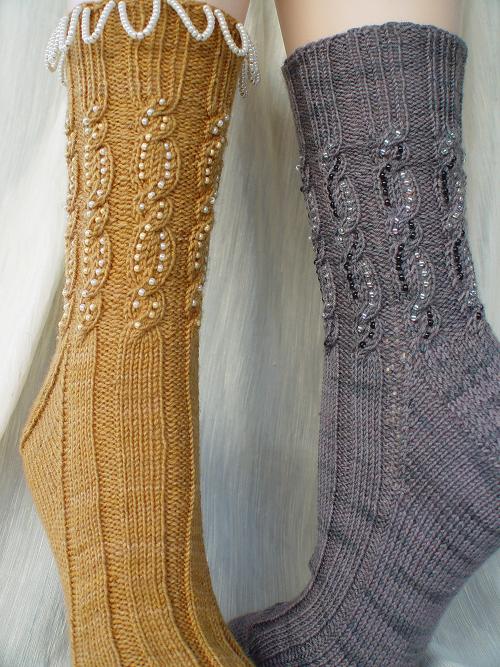
For example, when I designed the variation of Daylight and Shadows Beaded Cable Socks that has beaded swags at the top of the socks, I made sure there was ample ribbing in the cuff of the sock to support the bead weight.

On left: Swags of Beads embellish the top of this sock variation.

On left: Swags of Beads embellish the top of this sock variation.

Have fun playing around with beads!


Posted in Tips & Techniques | Tagged | Leave a comment

July 2013 Giveaway Results – Win Premium Time on KnitHeartStrings

Premium MembershipCongratulations to Beverly (greyhoundlover), winner of the July Prize Drawing.

This gives Bev an additional 12 months of Premium Level membership at KnitHeartStrings for free!

Stay tuned for announcement of what the August Prize Drawing will be for. Can’t wait to tell you about the prize, but since it is along the same theme as what our August KAL will be, I want to get more info about the KAL project posted first (I am working on the KAL pattern as fast as I can!).

Meantime, you can click here see how to enter monthly drawings and the kind of prizes we have had for previous months.

Thanks to all who have entered the drawings and played along so far.

Posted in Just for Fun | Tagged , | Leave a comment

Extending free download of July’s KAL pattern a few days

I am so darn far behind this month. It’s impossible to keep up with the computer stuff when we are traveling.

Maybe you have been busy, too, with vacation, etc.? Because there haven’t been nearly as many downloads of the free KAL pattern for July.

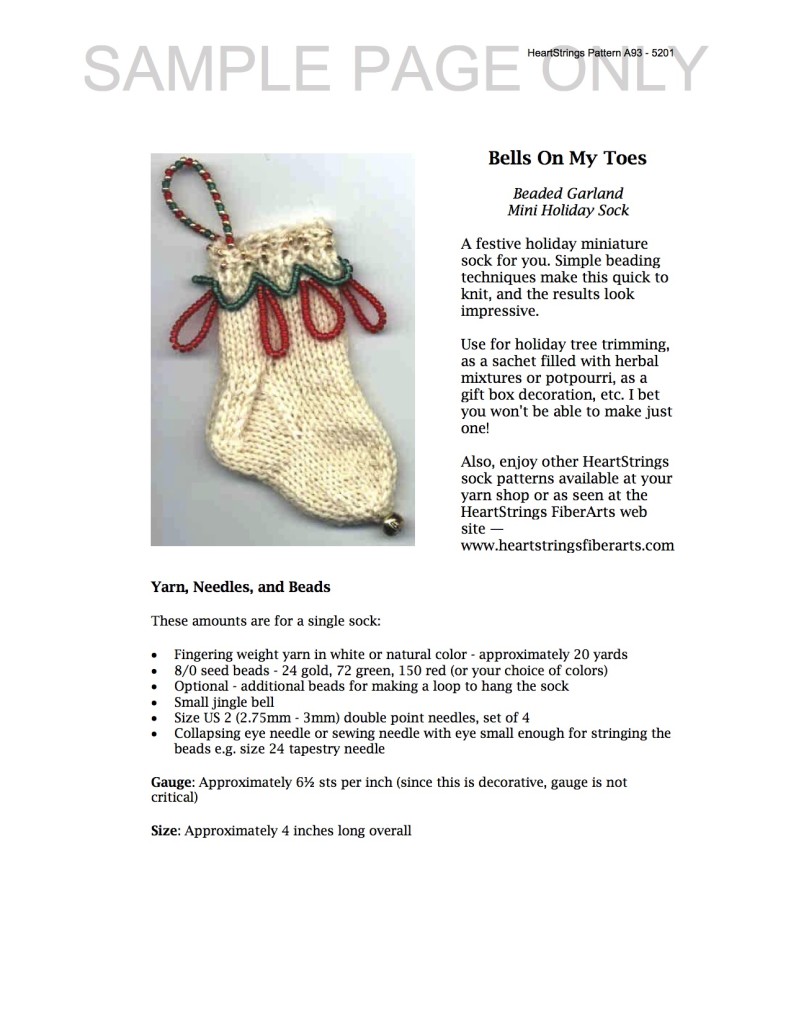
Pattern cover sample page Bells On My Toes Holiday Beaded Mini Sock

So I am going to leave it up for a few days more to download (free for KnitHeartStrings members) while I myself catch up on blog site articles and prepare for the August KAL project.

How does that sound?

Posted in Bits of Beads | 1 Comment

Do You Only Knit for a Practical Purpose?

Results of last month’s poll

A while back, I brought up the question about where the art of knitting fits (if anywhere) in our lives. It’s a been a while since I closed the poll Does your knitting have to have a practical purpose?

I think it is sometimes fun to have an excuse to think about silly random questions like this, so I didn’t expect the answers to be black and white — it certainly is not clearcut in my own mind. And it doesn’t really matter, I guess, except that again this month, I have presented you with a project that does not have a lot of practical purpose, lol. So thanks to those who are playing along anyway and having fun with the Holiday Beaded Mini SockContinue reading

Posted in Just for Fun | Leave a comment

Single Bead Placement in Front of Slipped Stitch

How to Place a Bead in Front of a Slipped Stitch (the first of 3 beading methods used in the Mini Sock project). Includes design goals and limitations to consider when playing around with bead embellishments in your other knitting projects.

The first of the 3 beading methods used in the Holiday Beaded Mini Sock is to place a single bead in front of slipped stitch.  It is a slight variation on the beading method to place a bead between purl stitches from the right side, which we covered a couple of months ago. As a reminder, we used the latter method when Knitting the Bead Stars in the Mini Flag.

Both methods string the beads on the working yarn beforehand. But thereafter there are differences.

Review of Place a Bead between Purl Stitches from the Right Side (the method that was introduced in the Mini Flag project)

When a bead is needed in the knitting, a bead is scooted up close to the purl stitch that was just completed, then another purl stitch is immediately made so that the bead remains in a horizontal position on the running thread between the 2 adjacent purl stitches. The bottom example in the photo below shows this result.

The “bumps” of the purl stitches on each side push the bead forward so that it remains seen on the right side of the fabric.

3 similar, yet different, methods of bead placement in knitting

3 similar, yet different, methods of bead placement in knitting

How to Place a Bead in Front of a Slipped Stitch (the first of 3 methods used in the Mini Sock project)

By comparison, the middle example in the above photo is the method used in the Holiday Beaded Mini Sock. For this method, a bead is scooted up close to the purl stitch that was just completed, the next stitch is slipped with yarn in front, then another purl stitch is made. The bead remains on the running thread that extends OVER the slipped stitch.  So slipping with yarn in front, when you are working on a RS row/round is very important. The bead is in the same horizontal position on the running thread, but now it is lying between 2 non-adjacent purl stitches.

It is the running thread itself that is in front of the slipped stitch that keeps the bead facing out to the right side of the fabric, not the purl stitches themselves. So, another option would be to place the bead in front of a slipped stitch that has knit stitches on each side (top example in photo).

You can see the difference in results between purling vs. knitting on either side of the bead-in-front-of-slipped-stitch method. Which version is used in a pattern will depend on the design goals and functional purpose.

In the case of the Holiday Beaded Mini Sock, I chose to use the purl stitch version. Every other stitch of the k1, p1 ribbing is already a purl stitch, so it is just a matter of slipping a bead in front of the intervening k stitch. This really “pops” the bead forward to make the beaded embellishment prominent.

Minisock beaded ribbing

Minisock beaded ribbing

On the other hand, if you were to use the knit stitch version with k1, p1 ribbing, I think you will find that the bead gets partially hidden within the valleys of the ribbing. This makes the beaded embellishment less prominent. Possibly a design goal for another project, but I did not feel that was what we would want in this ornament. Your choice, though, if you want to do something different.

Stacking Beads in Columns

To create a bit of design and more “bling” effect on the cuff of the minisock, there are two rows of beads placed around the cuff. But because of the intervening slipped stitch, beads cannot be stacked any closer than every other row/round when using the bead-in-front-of-slipped-stitch method. You’ll want to keep this limitation in mind if designing your own beaded embellishments using this beading method.

Bead Spacing on a Row/Round

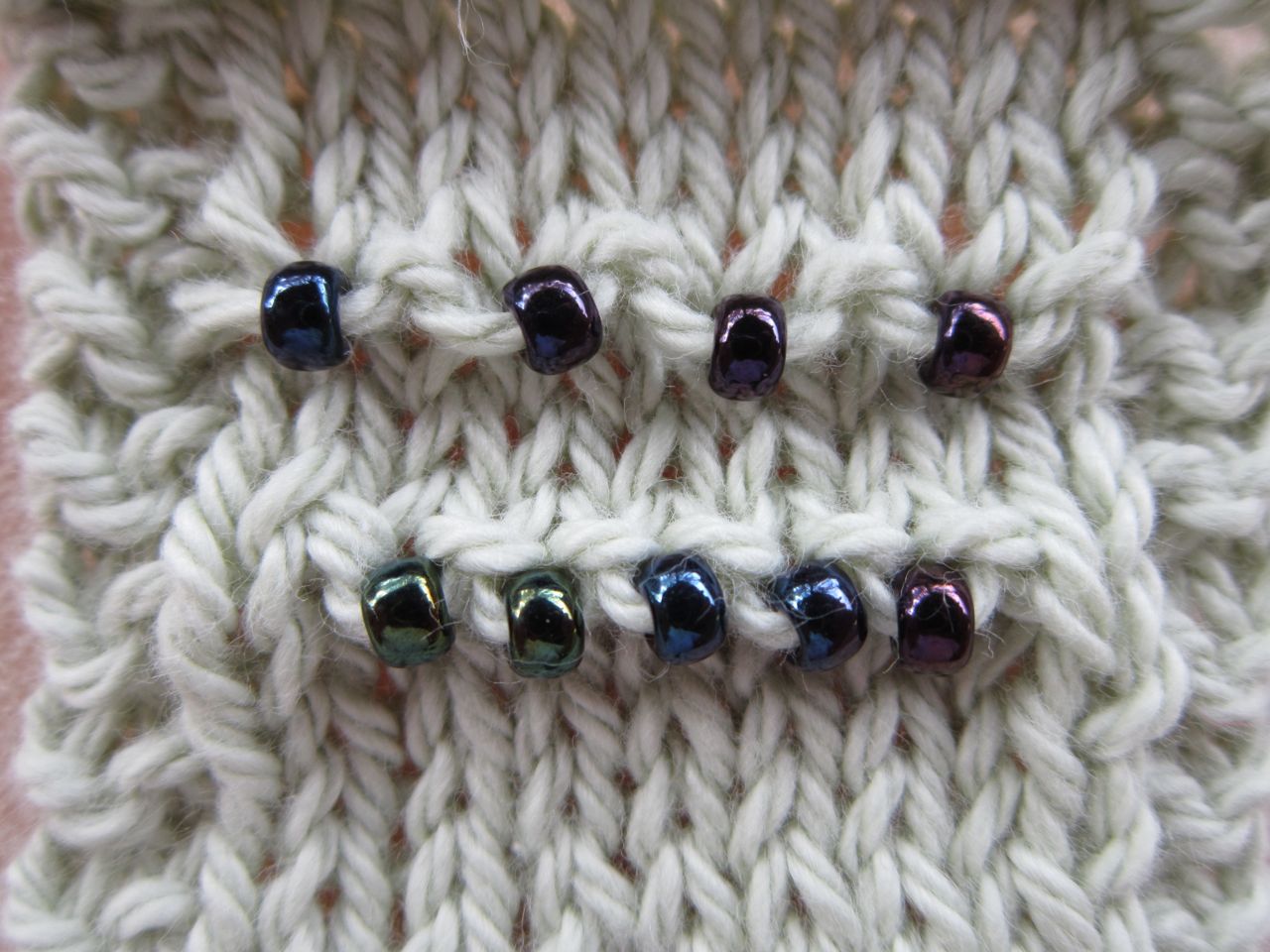
Another design limitation to keep in mind if doing your own designs with the bead-in-front-of-slipped-stitch method is that the beads can be placed no closer than every other stitch.

Comparison of bead spacing using 2 different methods of bead placement

Comparison of bead spacing using 2 different methods of bead placement

The lower example in the above photo is the method of placing a bead on the running thread between adjacent purl stitches. The beads can be lined up in an almost solid row.

The upper example is the method of placing a bead in front of a slipped stitch between non-adjacent purl stitches. The beads are spaced out more and cannot be placed any more closely using this beading method.

Play Around

I hope this will give you the inspiration and motivation to play around with bead embellishment on some other projects you do. For example, as you can see, this method of beading works perfectly with the k1, p1 ribbing on this mini sock. Next time, why not use this beading method to embellish the k1, p1 ribbing on some of your own socks?

Posted in Bit-size Tutorials | Tagged | Leave a comment