Stringing Beads in a Planned Color Sequence

Beaded knitting is fascinating and fun. There are multitudes of ways to incorporate beads into your knitting. Even the simplest methods produce impressive results.

Beaded knitting methods in BOBBOL 2013 projects (so far)

In previous monthly projects this year, we covered

3 More Methods of Knitting with Beads

In the Holiday Beaded Mini Sock, we will cover 3 more methods of knitted bead embellishment:

  • single bead placement in front of a slipped stitch
  • swags
  • fringe loops
Bells On My Toes Holiday Beaded Mini Sock

Bells On My Toes Holiday Beaded Mini Sock

These 3 methods require that the beads are pre-strung on your working yarn. To add to the interest, this project uses 3 different color beads that need to be strung in a certain color sequence.

Assuming you have your materials together as posted in the Shopping List of the Kick-off Post for Christmas in July KAL, then let’s get started getting those beads on the yarn!

Bead Stringing Instructions

Step 1: Yarn preparation

Be sure you have done the Preparation as described in the Kick-Off post.

Step 2: Prepare your bead stringing needle

Thread your bead stringing needle with your yarn.

Tip: If you have trouble getting your yarn through the eye of the needle, you can make your own larger “sewing thread eye”:

  • Thread the eye of your needle with the short length of sewing thread.
  • Holding both ends of the sewing thread together, make a simple overhand knot and pull snugly.
  • Clip the ends of the knot a short distance from the end.
  • Now you have an “eye” through which you can easily pass your yarn.
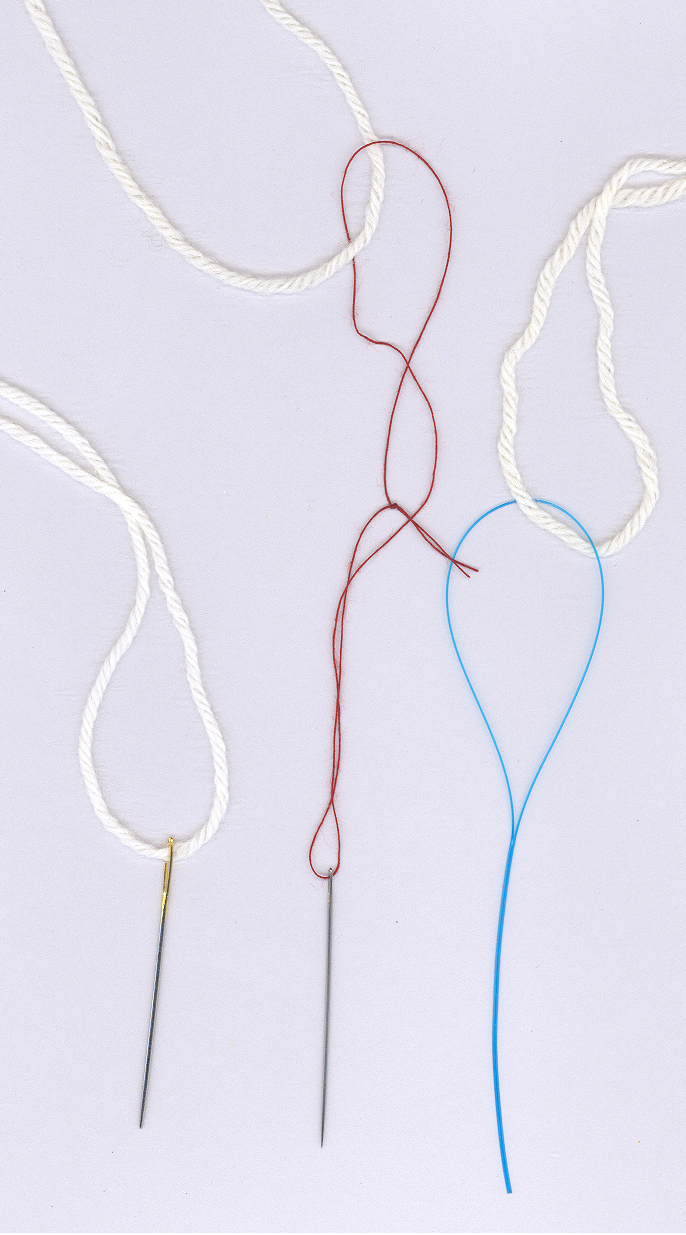
Kxxx-1

Examples of bead stringing needles threaded with yarn and ready for stringing beads:

  • Left – small tapestry needle
  • Middle – regular sewing needle with a “sewing thread eye”
  • Right – nylon collapsing eye needle (dental floss threader)

Step 3: Put each color bead in its own shallow container

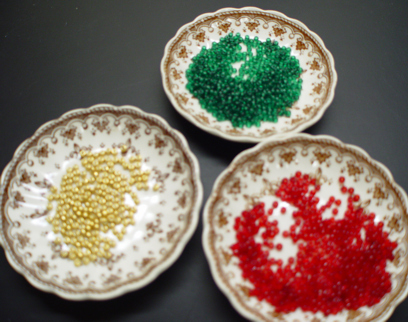
Put beads into shallow containers, one for each color. Small bowls/saucers, shallow box lids, or anything similar will work just fine. We just want to be able to easily access the beads without them rolling away!
Kxxx-2

Step 4:

IMPORTANT: The color sequence in which we string beads is in the reverse order to the order in which they will be knitted.

Thus, for the project as pictured above (and since the mini sock is worked cuff-down), you will need to string beads onto yarn as follows:

150 red, 72 green, 24 gold (or your choice of colors)

Tips for getting the beads on your bead stringing needle

How you get the beads onto the needle is a personal choice. Practice makes things go faster, so be patient and just experiment with what works for you best. Here are various ways you might try:

a)   Some people like to “scoop” the beads onto the needle tip by dipping the needle into the bowl/saucer in a somewhat sideways action. The beads find their way onto the needle in a hit-or-miss fashion.

b)   If using a firm tapestry or sewing needle, some people like to place the needle tip just to the side of a bead hole and “pop” the bead onto the tip.

c)    I usually just pick up a few beads in my fingers and place them onto the tip of the needle.

After bead(s) are on the needle tip, tilt the needle upwards to let gravity slide the beads closer to the eye of the needle. If you put your thumb over the bead(s) that are already on the needle, you can re-scoop or re-pop or otherwise put several beads on the needle. Then push the beads down over the eye of the needle and onto the yarn.
Kxxx-3

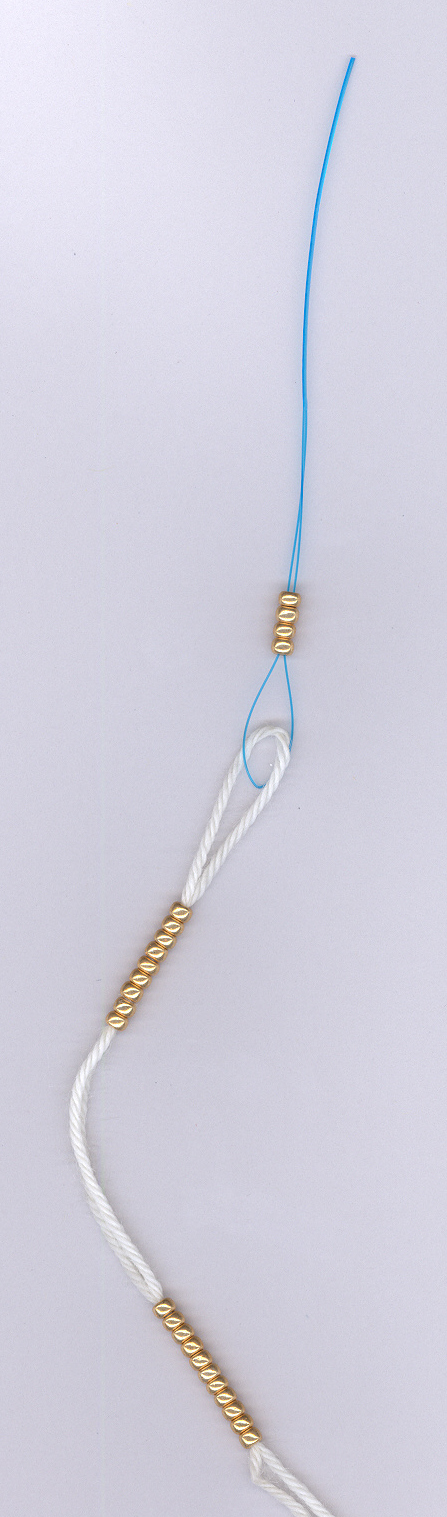
To left: I’m just about finished stringing my beads. The red and green beads are already pushed down along on the yarn (not shown in this picture), and the gold beads are the last ones to be strung since they are the first to be used.

Good Practice #1

Watch for defective or mis-sized beads as you go, and remove/discard these beads rather than stringing them onto the yarn.

Good Practice #2

Count the beads strung onto the yarn as you go, and then count again carefully once more before proceeding with casting on the stitches for your mini sock.
Kxxx-4

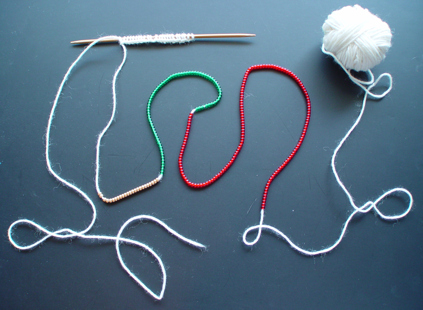
You will be sliding your beads back along the yarn as you knit, to hold them out of the way until needed.

Next Up

I’ll be back soon to go step-by-step through the 3 methods that are used in the mini sock. Any questions up to this point?

Posted in Bit-size Tutorials | Tagged | 3 Comments

Congrats to June’s Winner – Enter July Prize Giveaway Now

June Prize Giveaway Winner

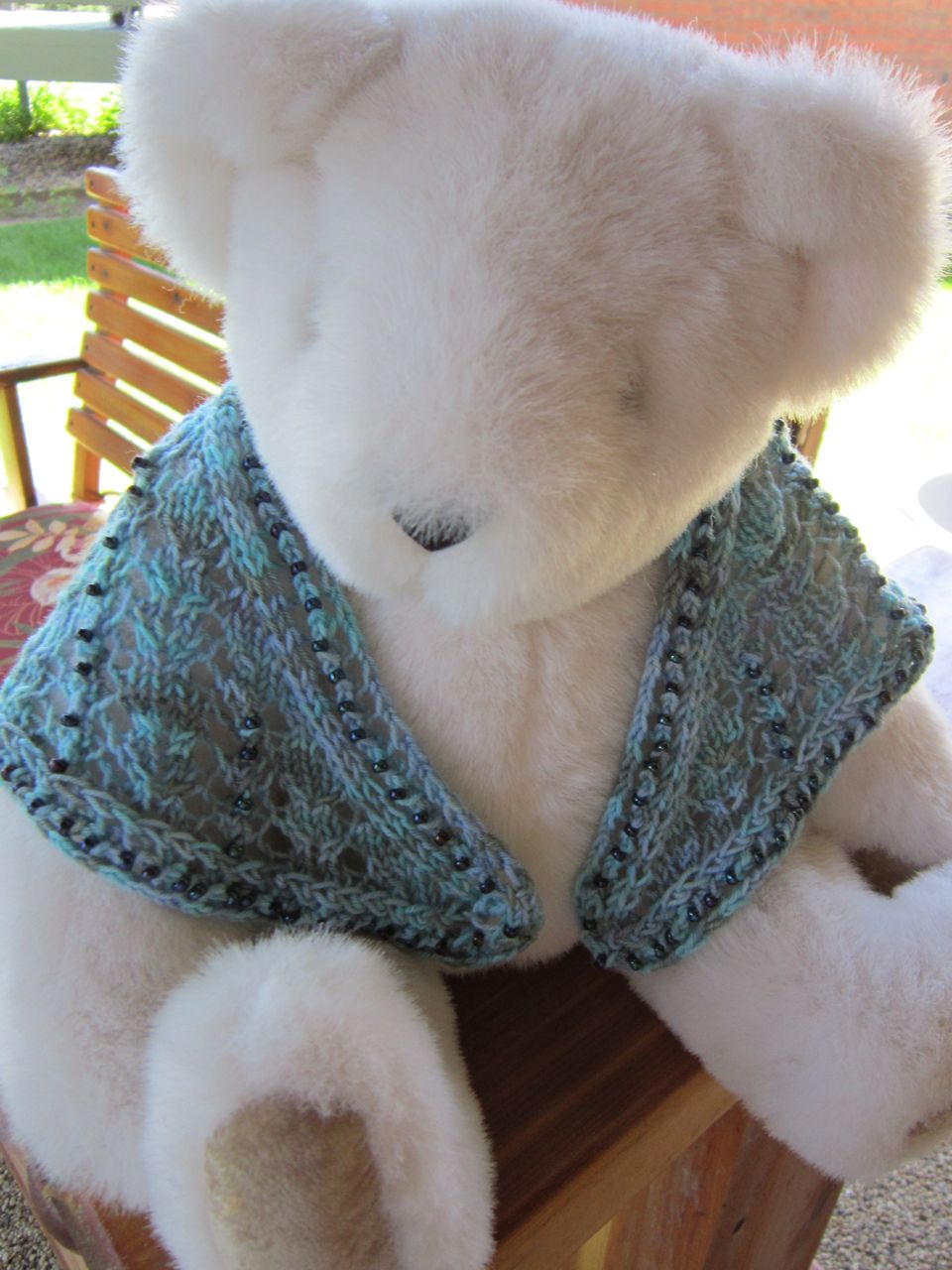
Congratulations to Mary Mauz, winner of the KnitHeartStrings June Prize Drawing for the special one-time kit with yarn, beads and autographed pattern for making Dolly’s Top-Down Tri Shawl. Thanks so much for everyone’s entries.

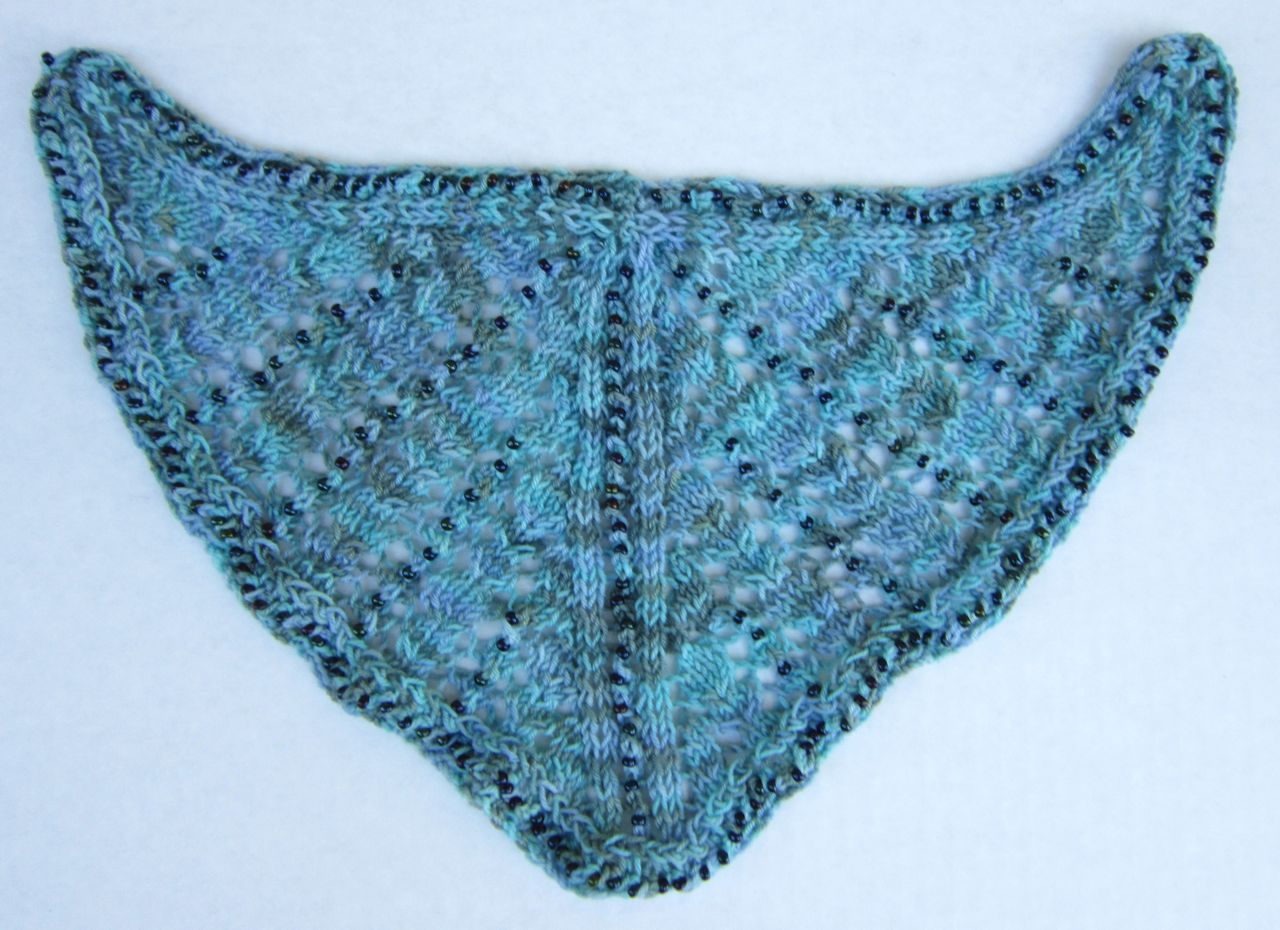
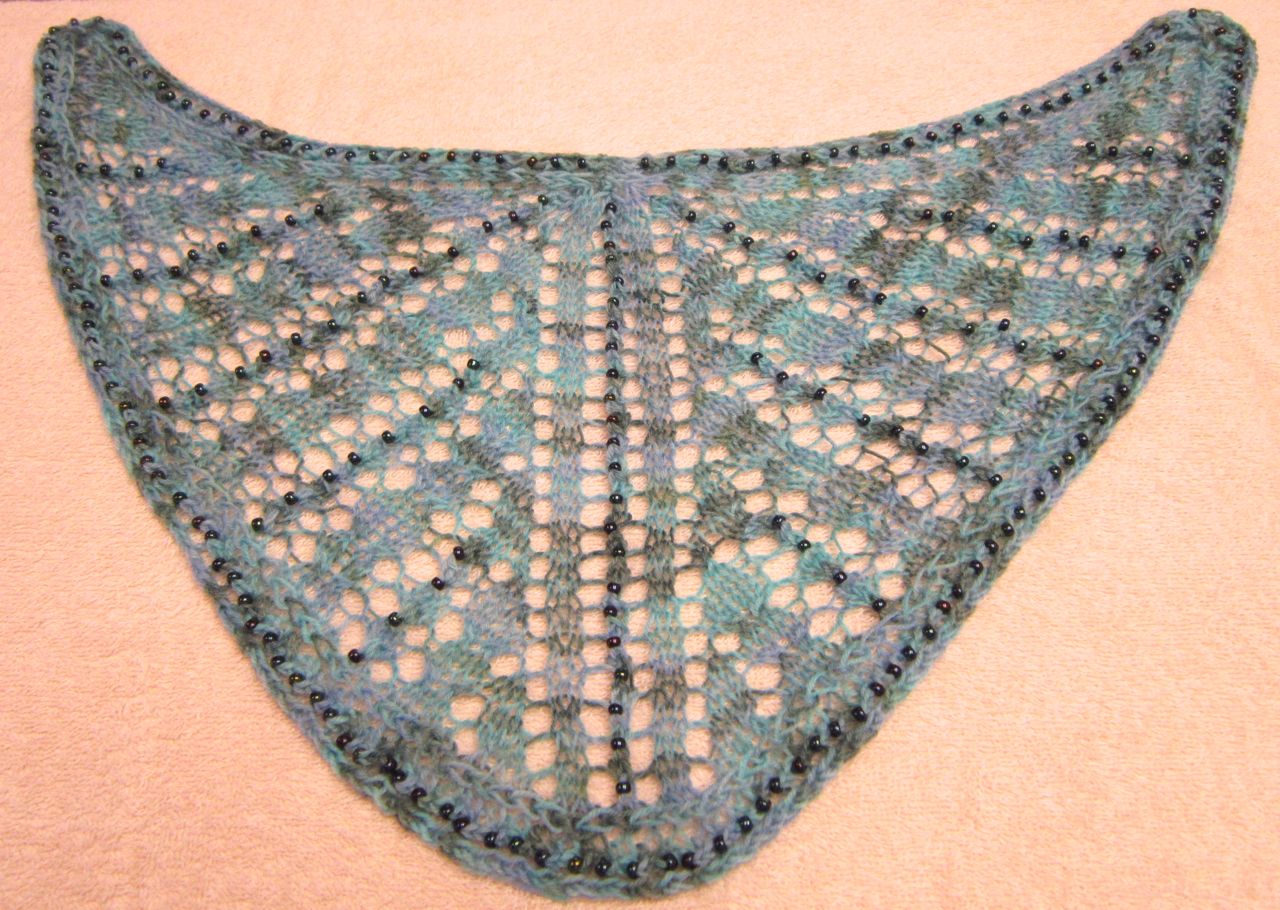
Dolly’s Top-Down Tri Shawl

Dolly’s Top-Down Tri Shawl

Mary has been with KnitHeartStrings since the very beginning of Bits of Lace (she has the very low member# of only 17!).  So I am especially happy that one of our long-time, super-supportive members came up as the winner in the random drawing for the June Prize.

Actually she has stuck with me even longer than that, having taken the very first session of Triangular Lace Shawl class I taught at Needlecraft University in the spring of 2005! (You can see the lovely shawl she knit for the class on this Show and Tell page.)

It just goes to again show how knitting brings us together in long-standing friendships.

Enter July Prize Giveaway Now

Win Premium Time on KnitHeartStrings

For July’s prize drawing, I’ll be giving away a Premium Level Membership valued up to $39!

Premium MembershipThe value and type Premium Level Membership awarded will depend upon the winner’s membership level as of July 31, 2013. See the Prize Giveaway page for more information and how to enter.

Posted in Just for Fun | Tagged , , | Leave a comment

Kicking off Christmas in July KAL

For July, our KAL project is fittingly in the theme of Christmas in July and features  knitting with beads in colorful ways.

Bells On My Toes Holiday Beaded Mini Sock

Bells On My Toes Holiday Beaded Mini Sock

Bells On My Toes is a festive holiday miniature sock for you to knit with beads and a bell. Simple beading techniques make this mini sock pattern quick to knit, and the results look impressive. I bet you won’t be able to make just one! Continue reading

Posted in Bits of Beads | Leave a comment

Extra Bonus: Sizing Up Dolly’s Top-Down Tri Shawl

You can use this outline for upsizing the doll-size pattern to child size or even adult size.

Wouldn’t it be great to make coordinating doll and child size shawls for a daughter/grand-daughter/niece/etc.?

Because of the top-down triangle shawl shape, making an adult size (or any size) from  Dolly’s Top-Down Tri Shawl is quite easy. Here’s how.  Continue reading

Posted in Bit-size Tutorials | Leave a comment

The Continuous Attach-as-you-knit Lace Edging Bind Off

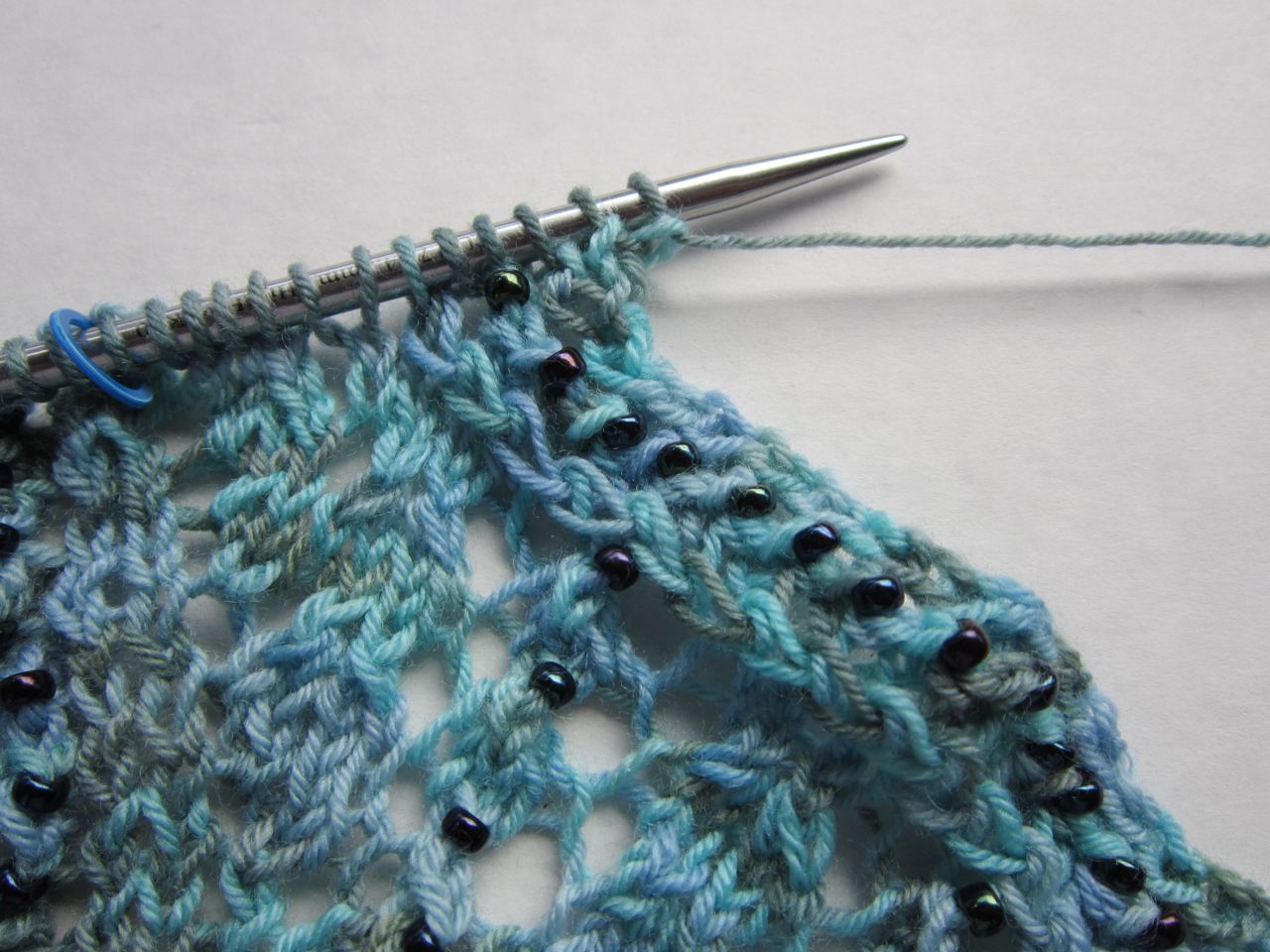
Dolly’s Top-Down Tri Shawl features a continuous strip of beaded lace edging along front bands and bottom of the shawl. See how in this photo tutorial.

To complete Dolly’s Top-Down Tri Shawl, we knit an edging onto live stitches, thus using the edging to bind off the stitches.

This is not going to be totally new to many of you who were around for last December’s knit-along. We’ve had a project before, A Bit of Lace Dolly Faroese Shawl, where we used the Attach-as-you-knit Method for Lace Edging as a Bind Off.

What is different with the Continuous Attach-as-you-knit Lace Edging Bindoff is that –

1. The edging just continues on the same stitches as the left-hand front edge band, rather than casting on extra stitches to start the edging.

2. Rather than binding off the stitches of the edging after all stitches of the side panels and center band, the edging stitches are grafted to the stitches of the right-hand front band. This creates the look of continuity of the edging for the right front band.

Note: Left-hand and right-hand refers to the shawl as worn. In the below pictures where the shawl is shown upside down, the left-hand front edge is actually to the right of the photo, and vice versa.

Short Row Corner

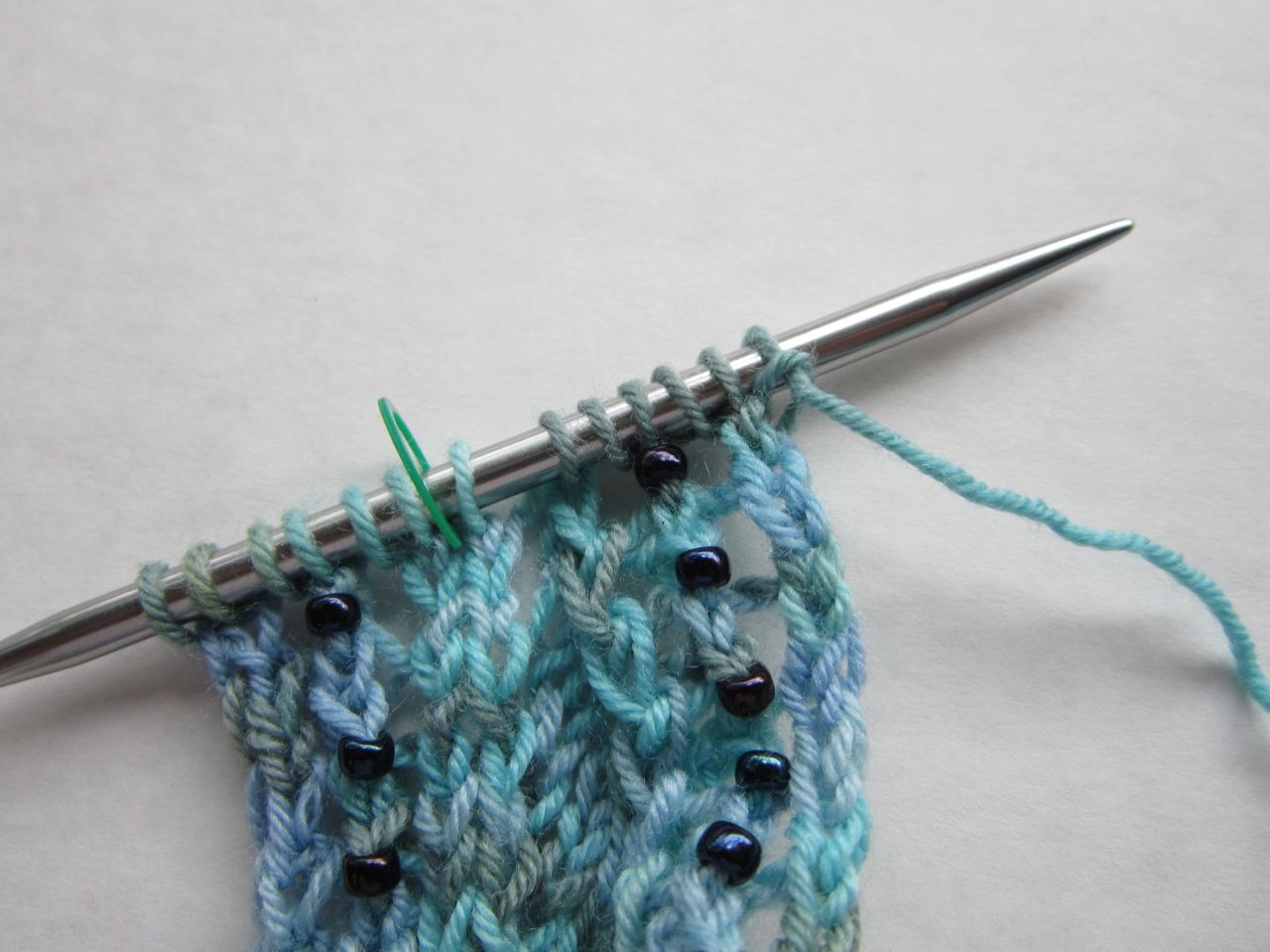
To begin the bottom edging, a series of short rows is needed so that the edge will lie flat as it makes the turn (lower right in photo below).

Shawl edging continuation of front band along bottom of shawl

Shawl edging continuation of front band along bottom of shawl

Binding Off

Then the beaded lace edging proceeds as usual for an “attach-as-you-knit” bind off. The final ssk of each RS edging row attaches the edging to a stitch in the shawl body, thus binding off one stitch.

Edging close-up

Edging close-up

The Other Short Row Corner

When all except the last stitch of the 2nd side panel has been bound off (i.e. 13 stitches total), it is time to do a series of short rows again so that the edging lies flat when it turns this corner.

Nearing the end of the edging

Nearing the end of the attached edging

Make sure you have completed the WS row of the attached lace edging before you start the series of rows for the short row corner.

Work the final short rows of the edging

Work the final series of short rows for the corner after you get to this point in your knitting

Note: The last stitch of the 2nd side panel will be bound off in the final RS row of the short row corner sequence, thus leaving 12 stitches total.

Graft Stitches

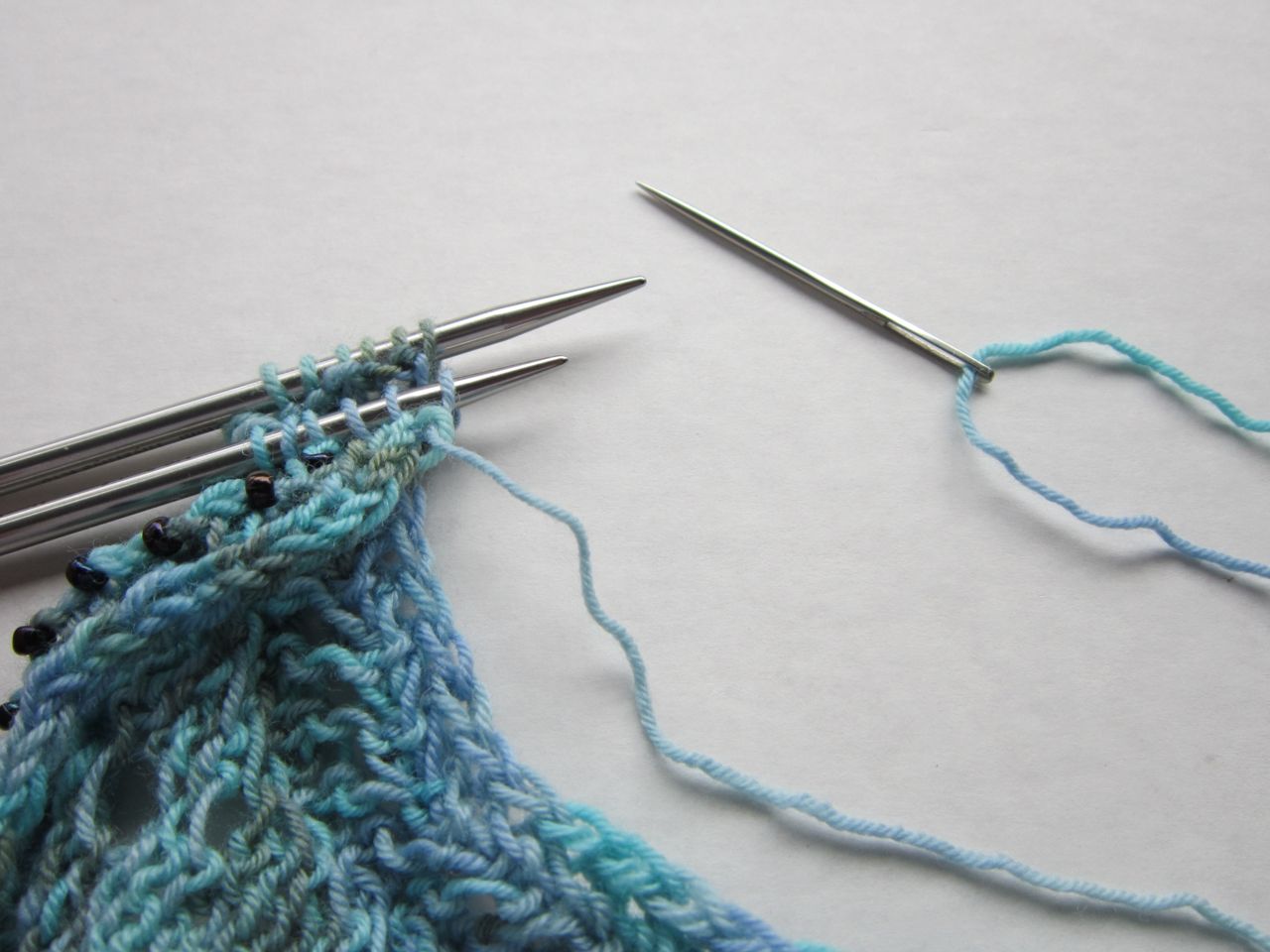
After completing the short row corner, you will setup the edging stitches so that they can be grafted to the other front band. Divide these on 2 needles (6 stitches each) and arrange as shown.

Setup the edging stitches to be grafted to the other front band

Setup the edging stitches to be grafted to the other front band

Here is a refresher on grafting stitches if needed.

Finishing Touches

There are just a few more things to do to after the attached edging is completed.

The edging is completed

The edging is completed

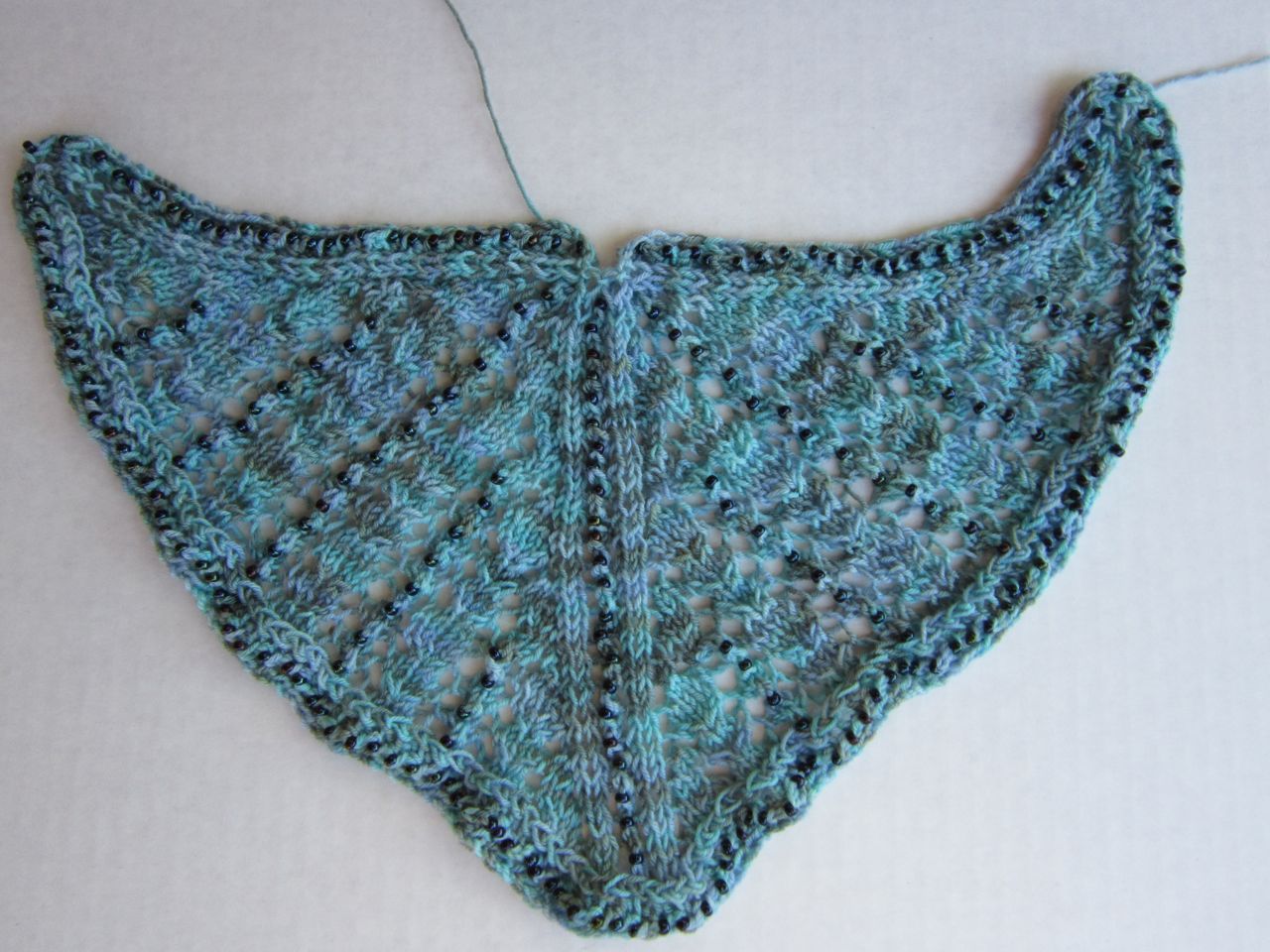
1. Weave together the center back neckline cast on stitches as instructed in the pattern.

Unblocked shawl after center back neckline has been seamed

Unblocked shawl after center back neckline has been seamed

2. Weave in ends on WS.

3. Block to open up the lace and even out the stitches.

Even a minimal blocking will open up the lace and even out the stitches

Even a minimal blocking will open up the lace and even out the stitches

Comments? Questions?

How are you doing with your dolly shawl? Thank you to those who have already checked in with pictures and comments. Everyone is welcome to share anytime.

Posted in Bit-size Tutorials | Tagged , , , | 2 Comments

Approaching the Finish Line of June’s Top-Down Tri Shawl KAL & Getting Ready for July KAL

Wow — where did the month go? We are just one day from the end of June, and that means we are approaching the finish line of Dolly’s Top-Down Tri Shawl knit-along.

I’ll be introducing the July KAL soon. Our focus will be knitting with beads in colorful ways.

Hint: Think Christmas in July (although there will be a totally different pattern this year than the Antique Satin and Lace Beaded Ornament that we did last year).

Early Access to July KAL Pattern for Premium Members

Premium Level members can get early access to the pattern for the July KAL right now via a special Ravelry coupon that will give you the pattern for free. Just go to Ravelry Library Delivery in the Premium Area to get the coupon.

Free Member Pattern in July

For Free Level Members, you’ll have access to a free download here on the KnitHeartStrings member site soon after the beginning of July. As usual, it will be available in the Free Member Pattern area after I get the site updated for July’s KAL in a few days.

2 More Articles for June’s KAL

Meantime watch for 2 more articles to finish out this month’s KAL to be posted later today and tomorrow respectively:

  • The Continuous Attach-as-you-knit Lace Edging Bind Off
  • Sizing Up Dolly’s Top-Down Tri Shawl from Doll-Size to Adult-Size
The beaded lace edging for Dolly's Top-Down Tri Shawl

The beaded lace edging for Dolly’s Top-Down Tri Shawl

Happy knitting! Hope you’ve been enjoying the June KAL and will be knitting along with us for the July KAL coming soon.

Posted in Bits of Beads AND Lace | Leave a comment

Tips and Techniques for the Main Body of the Top-Down Triangle Shawl

Hope you are enjoying the dolly shawl knit-along and accompanying articles so far: Roadmap for a Top-Down Triangle Shawl and Setting Up the Center Back Neckline. Here are some things to keep in mind when proceeding with the Main Body of Dolly’s Top-Down Tri Shawl.

Stitch Markers

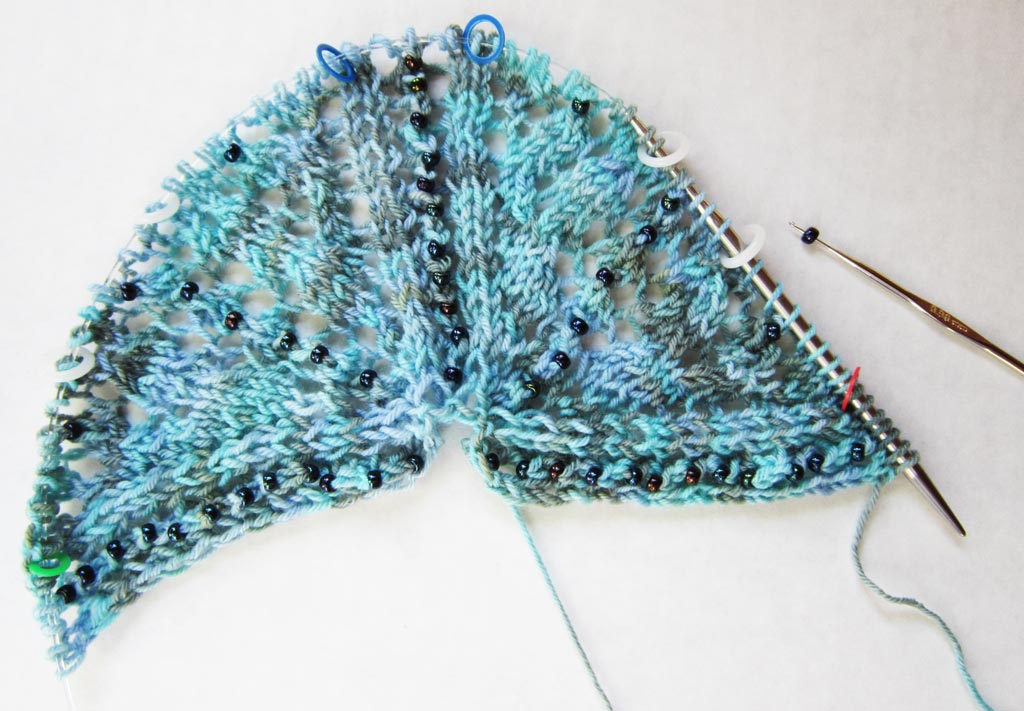
For the top-down triangle shawl, a charted area corresponds to each side panel in the Roadmap schematic we previously covered. The stitch markers placed on the Setup row help to easily keep track of where the chart sections begin and end. When working the remaining rows of the Main Body of Shawl, just slip these markers from one needle to the next as you come to them.

Tip: Different color markers can help remind you what part of the row you are supposed to be working.

In the below picture, the stitches between the red/light blue pair of markers corresponds to one charted section; the stitches between the dark blue/green pair of markers corresponds likewise to one charted section.

Proceeding with the Main Body of the Top-Down Triangle Shawl

Proceeding with the Main Body of the Top-Down Triangle Shawl

Tip: As the number of stitches increase, extra markers can be used to help delineate the 7-stitch multiples shown by the heavier vertical lines on the charts.

In the above picture, the extra markers are white. Of course you can use any colors you want, but I strongly advise the extra markers can easily be differentiated by either color, shape or something.

Chain Stitch Selvedge

All rows of the main body of shawl begin with “sl 1 (purlwise) wyif” and end with k1. This creates a nice chain selvedge edge that will be stretchable enough to accommodate the extra distance needed across the diagonal leg of the triangle.

You can also review last year’s articles for How You Slip Does Matter and Q&A re. Chain Stitch Selvedge.

Stockinette Lace and Rest Rows

This dolly shawl pattern is another example of Stockinette Lace Knitting. That means that all the lace patterning (i.e. making yarn overs/holes) is done on the RS rows. The WS rows are “rest rows” of (mainly) purl stitches. The exception to the WS row purl stitches is the “sl 1 (purlwise) wyif” at beginning of row and the “k1” at the end of the row as discussed above to create the chain stitch selvedges.

You will appreciate these rest rows more as the shawl gets wider! (Especially if you were making an adult size, which is actually really easy to do with this same doll-size pattern …  I will give you tips for this in a future article.)

Placing a Bead AFTER Creating a Stitch

For the Pretty Awesome Yarn Pouch, we used a crochet hook (or equivalent hooking method) to pull a stitch loop through a bead BEFORE working into the stitch.

For this dolly shawl pattern, I wanted you to see why sometimes a design will have you pulling the stitch loop through a bead AFTER creating the stitch.

In the stitch pattern design, beads are placed on RS rows atop some of the cdd stitches. To position the bead properly from the RS, the cdd stitch is created first, then the resulting stitch loop is pulled through a bead. Note: If you try placing the bead before making the cdd stitch, I think you will quickly see your dilemma. Can you guess why?

Tip (for advanced knitters): If you prefer, you can defer placing the bead until the return WS row. To do this, purl until just before the cdd stitch that should have been beaded on the RS row. Before purling into the cdd stitch, place the bead on the loop of the stitch, return the stitch loop to left-hand needle, and purl into the stitch.

Caveat: Since you will be working from the WS, you will have to pay attention more carefully than if placing beads on the RS as directed in the pattern. I myself find it faster to place the bead before making  a stitch, so the inconvenience of this “defer until next row” is a good trade off to more careful attention. Your mileage may vary. Give both ways a try and then you can decide what is best for you.

Next Up

Photo tutorial for the edging of Dolly’s Top-Down Tri Shawl.

Posted in Tips & Techniques | Tagged , , , , , , | Leave a comment