Part 1 of the Seemingly Seamless 2-Needle Preemie Hat has been posted

For February we are getting back to doing lace. I hope you enjoy Seemingly Seamless 2-Needle Preemie Hat. This project is the first in BOBBOL 2013 to expand our previous 2012 scope of Bits of Lace beyond edgings into other types of small lace projects.

This preemie hat is simply knit flat back and forth on 2 needles. What is clever is a technique that hides the seam in plain view. Your knitting friends won’t believe you didn’t knit this hat circularly!

I posted the Shopping List on the KnitHeartStrings member site yesterday. Did you see it? As with our previous projects, you won’t need much yarn. So shopping in your stash might turn up something you can use. Even a lonely partial ball of fingering weight machine washable/dryable yarn could find a home with this project.

Seemingly Seamless 2-Needle Preemie Hat is sized for premature babies, but you can easily upsize it for larger newborns and older babies by adding pattern repeats or making with thicker yarn on larger size needles.

I’ll be doing something different this month in making the pattern available free to members via the website. There will NOT be a pdf download. Instead, the pattern will be posted in pieces and available on special member-only content pages during February.

Part 1 of Seemingly Seamless 2-Needle Preemie Hat for Starting the 2-Needle Preemie Hat is available now for member viewing during February 2013.

Posted in Bits of Lace | Leave a comment

Seemingly Seamless 2-Needle Preemie Hat

Today marks the kick-off for February’s BOBBOL 2013 Knit-A-Long!

For February we are getting back to doing lace by making the Seemingly Seamless 2-Needle Preemie Hat. This project is the first in BOBBOL 2013 to expand our scope of Bits of Lace beyond edgings into other types of small lace projects.

[wp_lightbox_prettyPhoto_image link=”http://www.heartstringsfiberarts.com/images/b7apple-800.jpg” description=”Preemie Hat on an apple simulates the size of a large premature baby’s head” source=”http://www.heartstringsfiberarts.com/images/b7f.jpg” title=”BOBBOL 2013 Series”]

The Seemingly Seamless 2-Needle Preemie Hat is simply knit flat back and forth on 2 needles in a herringbone lace and ribbed pattern stitch. What is clever is the seemingly seamless seam that turns this flat knitting into a circular hat. This pattern reveals the secret that makes this work. Your knitting friends won’t believe you didn’t knit this hat in-the-round!

Note: Seemingly Seamless 2-Needle Preemie Hat is sized for premature babies, but you can easily upsize it for larger newborns and older babies by adding pattern repeats or making with thicker yarn on larger size needles.

Get on over to the Free Member Pattern area now to get started with us making the Seemingly Seamless 2-Needle Preemie Hat.

p.s. The pattern for the Preemie Hat will be free to members only during February 2013.  There will NOT be a pdf download available during February. Instead, the pattern will be posted in pieces and available on special member-only content pages at this website.

Posted in Bits of Lace | 5 Comments

Minimalist Seaming

Let this Get Ready – Get Set – Go instruction outline help you make an easy, no-show seam for a beaded garter stitch cuff.

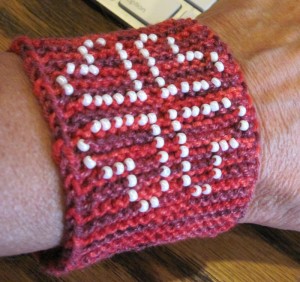
The Beading Hearts Friendship Bracelet is first knitted sideways in garter stitch as a strip of fabric. To form that fabric into a circular bracelet, there has to be some sort of seam to join the beginning and end of the strip. I want to bring to your attention some of the details included in the pattern that help you make an easy, no-show seam for this project.
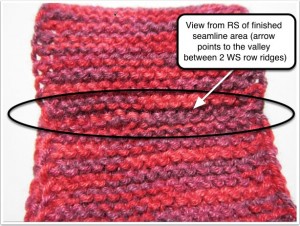
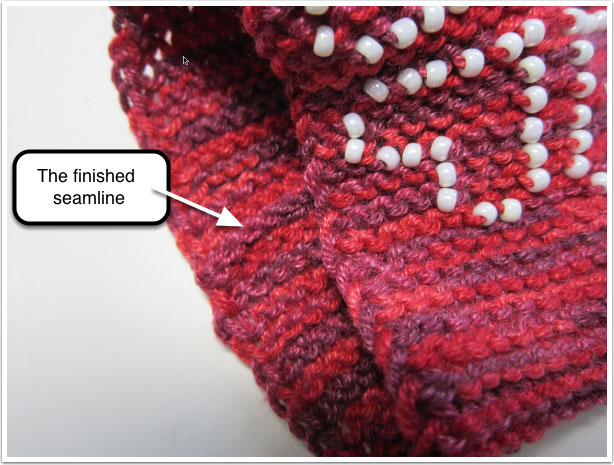
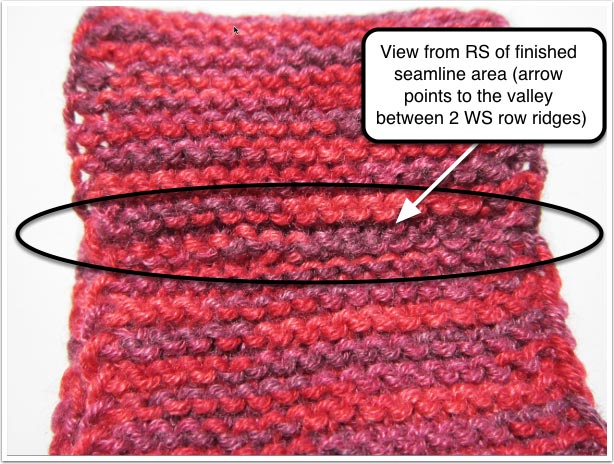
The seam line area is essentially invisible from the RSAlthough it might be tempting to not be concerned about how a project will be finished when you are just in the first stage of the project, there is just as much thought that should go into starting a project as in finishing the project. I call it “finishing starts at the beginning”.

Get Ready

A good start leads to a pleasing finish. When beginning the Friendship Bracelet, use a simple half-hitch cast on.

Using the simple half-hitch cast on method will minimize seam bulk when later joining the strip of knitted fabric. The simple half-hitch cast on is made by forming a backwards loop of the yarn on your thumb, then inserting needle tip through the loop (sometimes referred to as a simple cast on, or one-tailed cast on, or the thumb method of casting on). You can also review this previous Knit HeartStrings article – Simple Cast On :: a time and place for simplicity.

Get Set

For a beaded garter stitch strip that will later be joined, the first knitted row is a WS row.

This sets up the first part of the sequence of “ridges” so that when the cast on is joined to the end of the fabric, there will be a matching “valley” between the ridge of the first row of knitting and the last row of knitting when viewed from the RS.

Go

After fabric strip is long enough AND completing a WS row, bind off.

This sets up the 2nd part of the sequence of ridges so that when the cast on is joined to the end of the fabric, there will be a matching valley.

Finish

Sew together the cast on and bound off edges with the yarn tail left after binding off and cutting.

For sewing, you can either

1. hold the RS’s together and whip stitch from the WS the edges of the cast on and bound off edges together, or

2. hold the WS’s together and graft from the RS the loops of the first WS row with the loops of the last row (the intervening row of Kitchener stitch grafting forms the “valley” between the 2 ridges of WS rows).
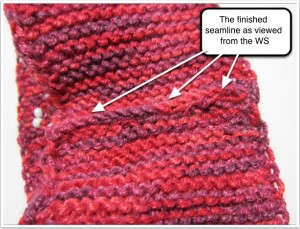
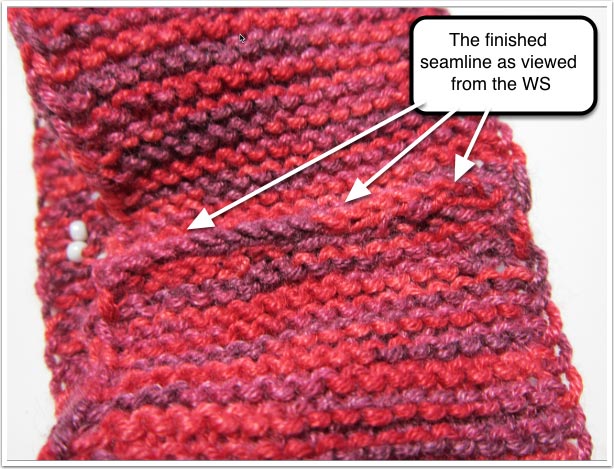
The finished seam line viewed from the WSIn both cases, the fabric as seen on the RS will have virtually an invisible seam line. Even though the WS will have some extra bulk at the seam line, it will be minimal. Not a thing to really cause any problem since this beaded garter stitch friendship bracelet has a definite RS (i.e. the side that the beads show up on), the WS is not intended to ever be seen when worn anyway.
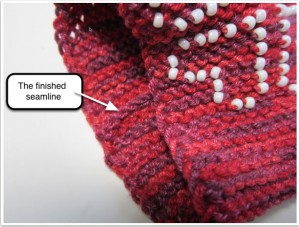
The finished seam

Tip: After the seam is sewn, the yarn tail used for seaming will be at one edge of the bracelet, and the cast on tail at the other edge of the bracelet. Therefore you do not have 2 yarn tails at the same edge producing extra bulk at one edge and none at the other.

More than you wanted to know? I hope not. But if it doesn’t make sense or mean anything now, just know that as a member of KnitHeartStrings that you can come back and look at  later.

p.s. Alternatively, there is a slightly more involved minimalist seaming method that substitutes a 3-needle bind off and eliminates the sewing step. Would you like me to cover that later?
Posted in Bit-size Tutorials | Tagged , | 7 Comments

Tidy Stretchy Edges

When you were knitting the Beading Hearts Friendship Bracelet, did you recognize the Chain Stitch Selvedge from some of last year’s projects like the Lace Cable Bookmark and the Three Eyelets Sachet?

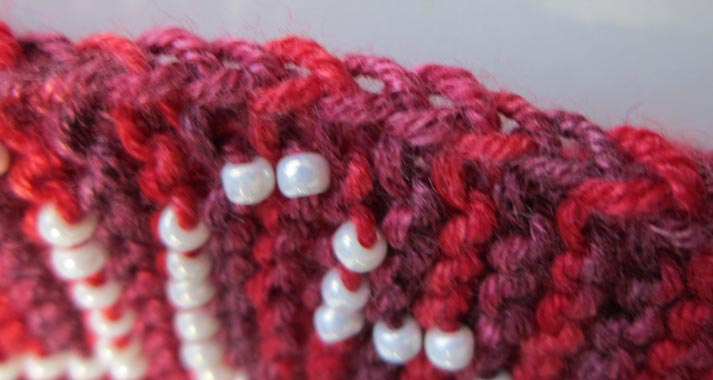
The chain stitch selvedge mades a tidy smooth edge that is stretchy, too

The chain stitch selvedge mades a tidy smooth edge that is stretchy, too

The bracelet is worked sideways in garter stitch with a slipped stitch chain selvedge at each edge. The Chain Stitch Selvedge makes a tidy perpendicular straight line along each side edge of the garter stitch fabric. Do you see how the “chain” of the chain stitch selvedge lies sideways to the adjacent stitches?

The other advantage, besides the aesthetics of the chain stitch selvedge, is that the selvedge compliments the elasticity of garter stitch.

The chain stitch selvedge is not critical to beading. It is just a nice detail for an item like this bracelet.

To get maximum stretchiness yet a tidy appearance for garter stitch cuffs like the Friendship Bracelet, How you slip DOES matter. And the type stitch you slip matters.

As a reminder from How You Slip Does Matter – The Chain Stitch Selvedge, here is the formula to make a chain selvedge –

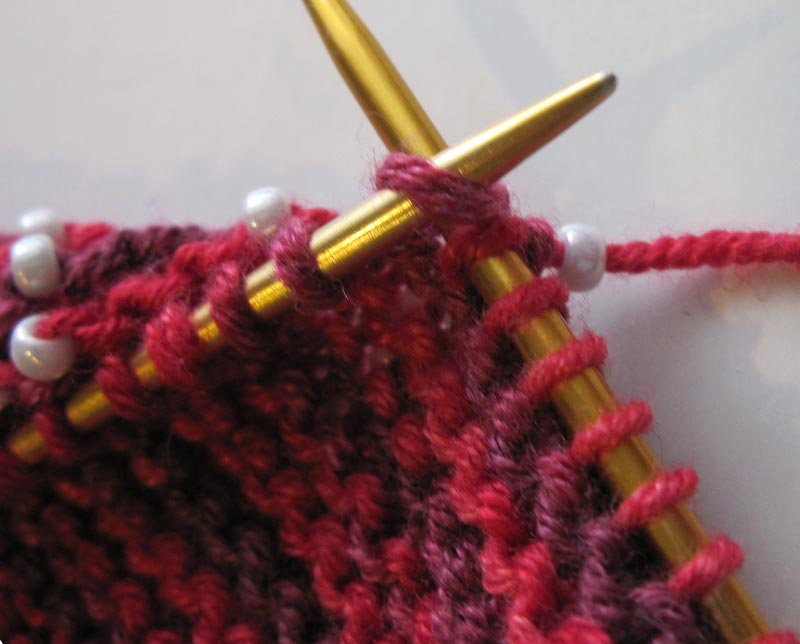
  • Begin each row on which you want a stretchy chain selvedge with sl 1 pwise wyif
    Tip: Keep your tension relatively loose, but not so loose as to get sloppy.
  • For the return row, end with k1.

The chain selvedge is also an often-used smooth-looking selvedge for lace articles that are going to be severely stretched during tension blocking. It’s a great technique to have in your knitting bag of skills.

Posted in Tips & Techniques | Tagged , , | Leave a comment

Reasons for Pulse Warmers

Last week in A Peek Behind the Scenes, I wrote about how the beads do not show on the wrong side of Beaded Garter Stitch. This is an advantage for articles to be used for warmth, since the beads (which can get like ice in the cold) don’t touch your skin.

Beads do not show on wrong side of beaded garter stitch

Beads do not show on wrong side of beaded garter stitch

In the above photo, pretend you are knitting. The side currently facing you in the photo is the wrong side. Trust me that there are actually beads on the other side. But you can’t see them. Only to the left of the photo where I have flipped the knitting over a bit, can you see that there really are beads on the other side (which of course is what we use as the right side of the fabric).

Pulse Warmers are one of my favorite items  to make and wear using Beaded Garter Stitch. Rather than always listening to me about why, let Ellen Sandin of Earth Faire share her heart-warming (pulse-warming) story.

Beading Hearts Friendship Bracelet

Beading Hearts Friendship Bracelet

If you have been dithering about making Beading Hearts Friendship Bracelet, this might give you the incentive to make not only one, but to make a pair!

Do you have a story? We’d love to hear.

Posted in Bits of Beads | Tagged , | 3 Comments

Ideas for finding places to buy beads

I have started a page for Bead Sources (under the Member Services menu at the KnitHeartStrings.com site).

I encourage you to first check for sources of quality beads locally. Besides the obvious sources like bead shops (which unfortunately oftentimes do not have the type beads needed with larger holes for knitting with) and craft shops (which oftentimes only have cheaper, poor quality beads which will eat through your yarn), some yarn shops now carry quality beads for knitting. Also check with needlepoint, cross stitch and quilting shops that carry beads.

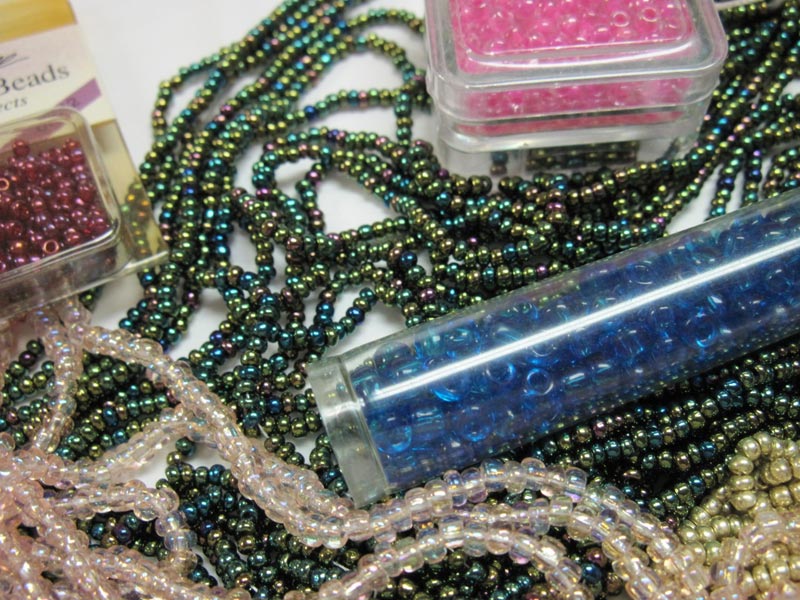
Assorted beads to use with knittingThe Japanese-manufactured seed beads for knitting are usually the most consistently uniform, smooth and have the most stable colors/finishes. My personal favorite brand is Miyuki.

If you have a place you like to buy beads from either locally or online, please let me know so I can add it to this list to help everyone find the beads they want and need for their BOBBOL 2013 projects.

If you are a business that sells beads and HeartStrings knitting patterns, I also invite you to let me know so I can add you as a source, too!

Posted in Bits of Beads | Tagged , | Leave a comment

Bead Row Pre-Counting Tip

A bit of quick bead counting can help avoid errors

As previously outlined in the Basics of the Beaded Knitting Technique, the beads that are strung on your yarn are pushed down along your yarn until needed. Then when needed, you slide a bead into the place it is to occupy between the last stitch made and the next stitch to be made.

For efficiency, I like to keep some beads closer to my knitting (so that they have less distance to slide when needed) and push the remaining beads along the yarn at least an arm’s length out of the way. A bit of quick bead counting has saved me countless times from discovering errors much later in my knitting and not so easily corrected. Here’s how to avoid the most common beading errors –

Counting beads before the row begins

Before beginning a row, I pre-count exactly the number of beads needed for that row and slide that portion close to my needles ready to be used. Then slide the remaining beads much further down the yarn and out of the way.

What if there are extra beads when the row ends?

When working the row, if I reach the end and have any beads left over, I know I overlooked placing bead(s) somewhere in that row and have only a (relatively) small number of stitches to unknit and correct.

What if beads run out before the row ends?

Likewise if I run out of beads before completing the row, I know that I have placed extra bead(s) along the row somewhere. I can figure out where the error occurred within the row and correct it before proceeding too far.

What about projects with lots more beads in a row?

The number of beads used in each row of this month’s Beading Hearts Friendship Bracelet project are relatively few, so it’s not going to take you very long to pre-count the beads. But if you were doing a project with longer rows and many more beads in each row, you can use the same concept to pre-count beads for just a portion of the row, such as a repeat between markers.

Of course, this bead counting tip is not going to totally assure you that the beads were placed in their correct positions for the beaded design. So it’s still good practice to visually check your work now and then to make sure it is looking reasonable.

p.s. To help you get used to the idea of pre-counting beads for a row, you might have noticed in the written instructions for the Friendship Bracelet pattern that I actually have given you the number of beads needed in each row.

Posted in Tips & Techniques | Tagged , | Leave a comment