Charting the Lace Edging for this month’s project

Cecelia wrote:

Sure wish this sweet little edging was charted. 
After all the discussion about reading charts,
 this would be a perfect project for practicing.

I am glad you are interested in practicing some more chart reading, and I assume several others are, too? Here ya’ go!

For those who have been following along, we’ve had some practice reading charts the last 2 months. For this month’s project, and for those who felt up to it, I suggested you take a shot at writing out your own chart. That was not a requirement, though, and of course I am here to share a chart with you.
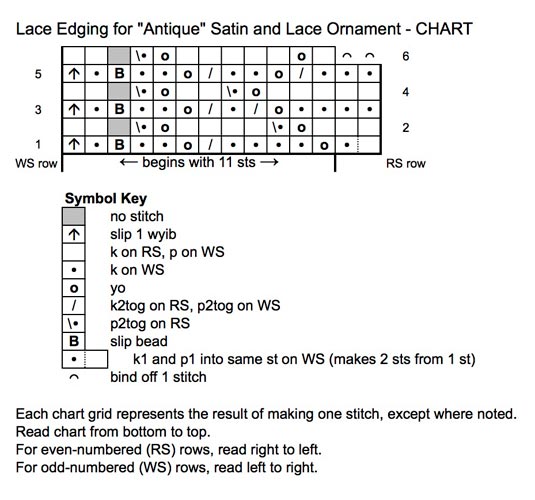
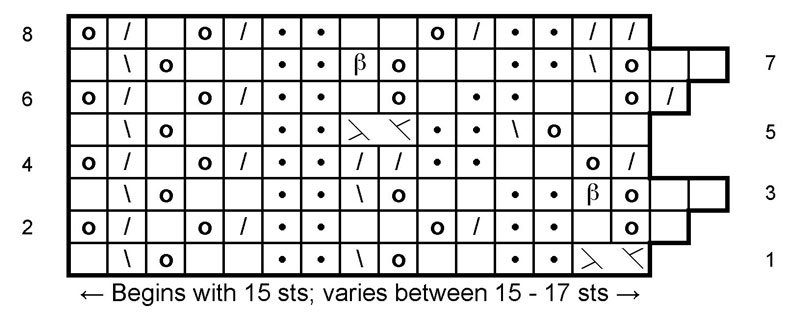
Chart for the Lace Edging used for the "Antique" Satin and Lace Ornament projectLearning Point 1: Shaped edge with bound off stitches

You’ll notice that this is the first chart we’ve encountered where the shaped edge shows bound off stitches (the previous month’s edge was shaped with interior decreases). In the ornament pattern, there are specific instructions for doing a k2tog bindoff. If you prefer to use another bind off, this chart shows exactly where you’d substitute your own.

Learning Point 2: Row numbering for RS vs. WS rows

Another observation to note is that it is not always the case that the odd-numbered rows are the RS rows (such as in our projects for the previous 2 months). For this edging, the odd-numbered rows are the WS rows. Different designers and publications will use one convention or the other. As long as clearly indicated (as I hope that you always find my patterns to be), this doesn’t present a problem.

p.s. I’ll be back in a few days with more tips and learning points. Please feel free to add your comments and questions here. I’m looking forward to hearing from you and how you are doing!
Posted in Bit-size Tutorials | Tagged | 8 Comments

Ornament Ball Tips for the Christmas in July project

In the Shopping List for the Christmas in July project I suggested –

  • 1 ornament ball, 7.5” circumference. If you have trouble finding a satin ornament, you may need to substitute a more readily available glass ball.

The circumference of the ball is the same as the slightly stretched blocked length of the lace edging you will make.

Tip 1: Adjusting for different sizes of ornament balls

To adjust for other sizes of ornament balls, keep in mind that more thread may be needed, and that the total number of beads you will need depends on the number of 6-row repeats it takes to encircle the ornament — 3 beads are needed per 6-row repeat.

Tip 2: Shopping for a particular size of ball

For shopping purposes (especially online where you cannot measure the ball you are buying), I should have realized that you might need some help in remembering the mathematical conversion to diameter (which apparently is the measurement that most online places are using).

If you recall from school days, the diameter is the longest distance through the center of the ball. Of course, your knitting is not going to be passing through the center of the ball, but it will be helpful to know this measurement if shopping online. Here is the formula:

diameter = circumference / PI
(where for our purposes PI can be approximated to about 3.14)

So for a 7.5″ circumference, the diameter would be approx 2.375″; (i.e. 2-3/8″ in fraction notation). Note: Sorry, if you downloaded this month’s project pattern after I attempted to update it with the diameter, I just realized that somehow the “3” of “.375” got dropped off – I’ve corrected that now.

Tip 3: Alternatives to using a satin-wrapped ornament ball

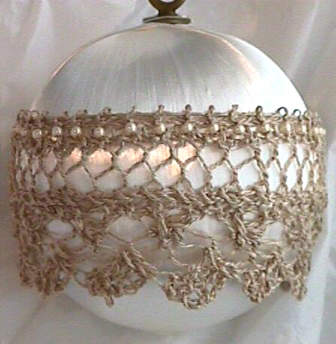
A white satin ball (thread-wrapped styrofoam) was used in the pictured model.

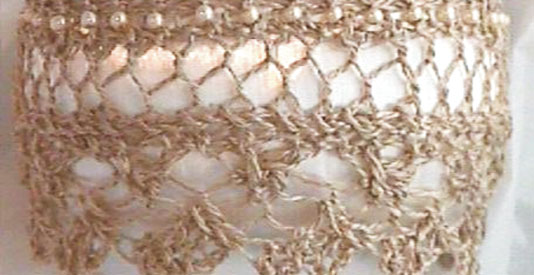
Satin-wrapped ornament with beaded lace edging

However, if you have trouble finding a satin ornament, you can substitute a glass ball and follow instructions in this month’s project pattern instructions for using clear craft glue instead of pins for attaching the edging.

Another possibility is to get a plain Styrofoam ball at the craft store. Then wrap it with some yarn you have on hand. Here is a link with inspiration and instructions:

Yarn Ball Xmas Ornaments by stitchstitch

I am looking forward to seeing what YOU come up with. Don’t be afraid to be inventive. I hope these ideas spark your creativity and interest even further!

p.s. Would you like me to offer kits for sale with a choice of colors for the satin ornament, thread and beads? I was even thinking I might save you the work of stringing the beads onto the thread and including the fine gauge pins for attaching. Let me know what you think with your comments here.


Posted in Tips & Techniques | Tagged , , , | 7 Comments

Thread Tips for the Christmas in July project

The Christmas in July project for Bits of Lace 2012 takes approximately 12 yards of fine thread in your choice of color. Here are 2 quick tips I hope will inspire you to experiment with  threads and colors you might not have tried before.

Antique Satin and Lace Ornament

"Antique" Satin and Lace Ornament

The thread I used in the photo is a 35/2 unbleached linen thread. (I’ll be talking about what the numbers like 35/2 mean in a later bit-sized tutorials.) Although size 20 crochet thread and size 8 pearl cotton as I mentioned in the Christmas in July – Shopping List post are a bit thicker than 35/2 linen thread, they are commonly available and will provide good results.

Thread Tip 1: In fine lace, thread size is less a determinant of gauge than needle size is.

You already encountered this adage in the “Choosing thread” bit-size tutorial a few months ago if you’ve been following along, but now is a perfect project on which to see it in action.

Just be sure that a single strand of your thread can pass through the holes in your beads.

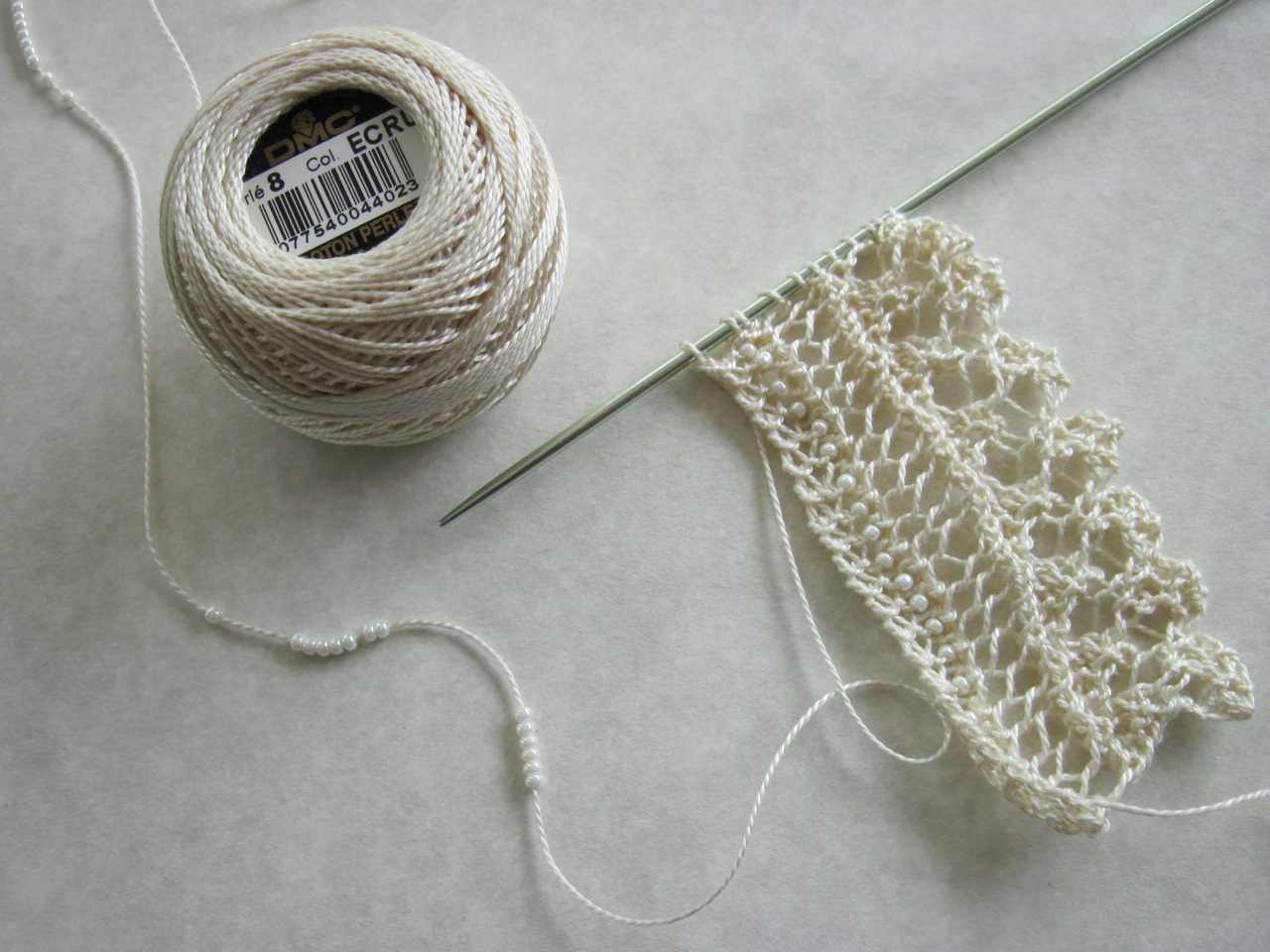
For example, I am currently working this project with DMC size 8 perle cotton in color Ecru and size 11/0 Miyuki beads in color Pearl Ceylon. It is looking great, don’t you think?

Beaded lace edging in progress

Thread Tip 2: Use tea dyeing for an “antique” look.

For an “antique” look, you can use an unbleached linen or cotton. Never fear, though, if your local shop or stash-diving doesn’t come up with any. You can fake it by dyeing a white thread in strong tea beforehand.

Posted in Tips & Techniques | Tagged , | Leave a comment

Christmas in July – Shopping List

On July 1st, I’ll post our Bits of Lace project for the month of July. It is a lovely Victorian-style ornament with a dainty lace edging and knitted-in beads.

Victorian style ornament with hand-knitted lace and beads

Even if you have not used tiny thread and tiny needles, this bit-sized project is just large enough to give you practice while not being intimidating. The beads are optional embellishment, but it’s an easy project for stringing and knitting with beads if you’ve been wanting to try this.

Here is the Christmas in July project materials list so you can shop or stash-dive ahead of time to be ready to start the project as soon as possible after the July free membership pattern goes live.

Shopping and/or Stash-diving List for Bits of Lace Christmas in July

  • Approximately 12 yards of fine thread in your choice of color, e.g. size 20 crochet thread, size 8 pearl cotton, etc.
  • 36 size 10/0 or 11/0 (2 mm) seed beads.
  • If you are using loose seed beads, some beeswax or paraffin will help in stringing the beads.
  • Size 1 US (2.25 – 2.5 mm) knitting needles.
  • 1 ornament ball, 7.5” circumference. If you have trouble finding a satin ornament, you may need to substitute a more readily available glass ball.
  • Small tapestry needle for joining and finishing ends.
  • 3 or 4 fine gauge sewing pins (if using a satin ball) or clear craft glue (if using a glass ball).
Posted in Bit-size Tutorials | Tagged , , | 15 Comments

What’s coming up for Bits of Lace?

From what I am hearing from so many of you, we are having fun! And learning and sharing, or just having an excuse to knit up some bit-size lace gifts for ourselves or loved ones. I am thrilled you are here to join in the fun, learning and sharing. With that, I am obviously encouraged to give it my all in continuing to bring you more good stuff.

Here’s a peek at the Bits of Lace calendar planned for the rest of the year (or at least what I hope it will be). As future months get closer, I’ll fill you in on more details about supplies and the learning points we expect to cover …

July: Christmas in July! Victorian-style ornament featuring beaded lace edging. Tiny thread. Tiny needles. We’ll cover these so you will feel more comfortable. The beads are optional embellishment, but it’s an easy project for stringing and knitting with beads if you’ve been wanting to try this. I’ll be back soon with the supplies list so you can shop or stash-dive in time to begin when the July free membership project goes live.

August: Lace-edged towel.

September: Lace-edged round fabric-center doily.

October: Lace-edged hanky.

November: Dolly shawl (top-down) with an attached edging as a bind off.

December: Wrap it up with lace ribbons!

How does this sound?

Posted in Bits of Lace | 23 Comments

Picot Loops for Easy Picking Up and Elasticity

For those who made the Quick Lace-Edged Baby Socks, you probably noticed a similarity to the lace edging for this month’s Summer Lace Anklets.

The straight edge heading of this lace edging has a yarn over at beginning of row to form picot loops. The edge remains straight (rather than increasing) because the yarn over is immediately followed by a decrease (in this case, a p2tog).

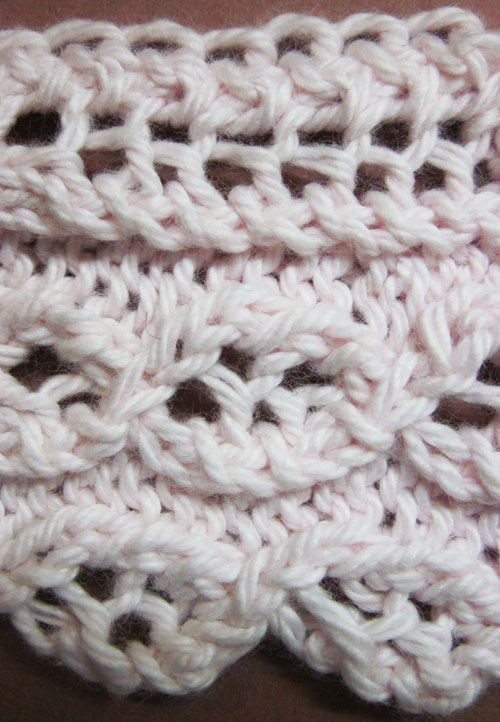
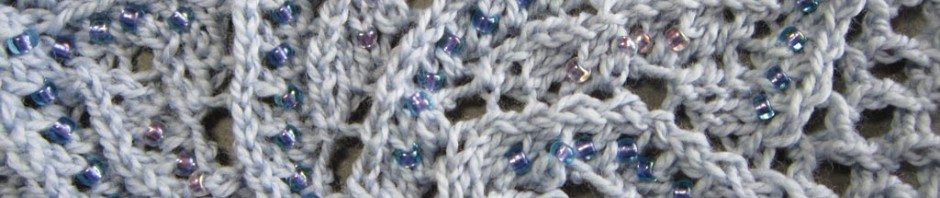
Picot loops are pictured along top of this lace edging

Picot loops are pictured along top of this lace edging

The picot loops make for a very easy, no-brain pick-up and knit to continue the knitting of the sock ankle, or any other item that requires maximum widthwise stretch.

Posted in Tips & Techniques | Tagged , , | 2 Comments

The Best Charting Style is … ?

The BEST charting style is obviously the one YOU prefer. Thanks to everyone participating with their comments about the two chart styles presented in last week’s bit-size tutorial. There clearly was a diverse set of opinions both pro and con because of the trade-offs in using the chart as a visual tool vs. a tool for aligning stitches in the working row to the previous row’s stitches.

What I really want you to take away from this is to feel comfortable with what you prefer and don’t prefer. There is really no right or wrong answer. But by seeing different styles, it becomes easier over time to deal with recognizing their similarities and differences if/when you encounter them. Don’t hesitate to translate them to your preferred way of seeing things. Either through mentally changing gears, or actually re-writing the chart in your preferred notation/style. Using help-mates like highlighting with your own visual cues can help, too.

For example, what happens when we come up with a hybrid version of the chart that attempts to take some of the best parts of each of those 2 styles? Let’s first give a brief redux of each style previously presented:

  • The chart with “no stitch” symbols more clearly showed there are interior decreases and increases, and where the actual stitches aligned when knitted.
Chart for Lacy Cable Scallop Edging in the "no stitch" style

Chart for Lacy Cable Scallop Edging in the "no stitch" style

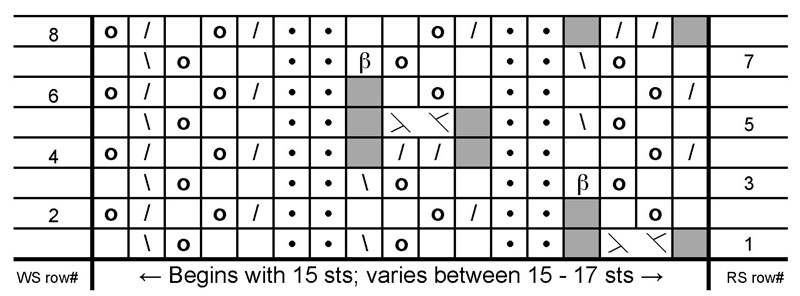
  • On the other hand, the chart without the “no stitch” symbols showed which edge was shaped. However, if you compare the visual of this chart to what results when knitted, you will see that your lace edge has only one scallop each 8-row repeat; i.e. not 2 scallops as might be inferred by just casually looking at this chart.
Chart for Lacy Cable Scallop Edging in the "shaped edge" style

Chart for Lacy Cable Scallop Edging in the "shaped edge" style

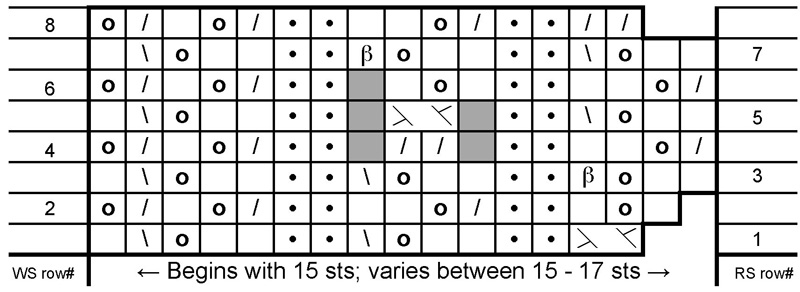
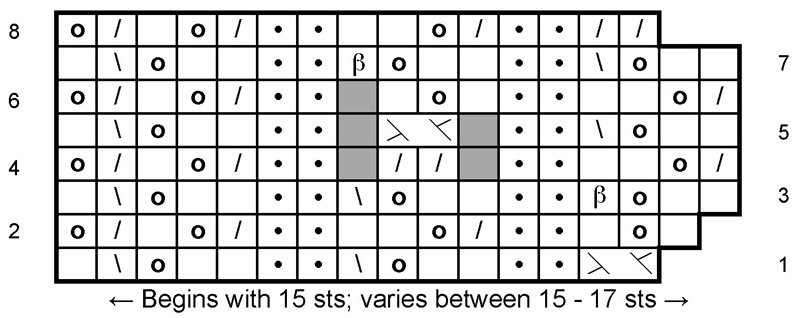
Here is a hybrid of the two chart styles presented in last week’s bit-size tutorial.

Hybrid chart

Hybrid chart

Several comments were also made about the preferred style of row numbering; i.e. with or without extended lines. Again, both have pros and both have cons. Here is a comparison of how the hybrid version looks without the line continuations for the row numbers:

Hybrid chart (without extended row number lines)

Hybrid chart (without extended row number lines)

Feel free to try out any of these other chart versions for knitting the edging of your Summer Lace Anklets. And as always, feel free to chime in with your comments and questions.

Posted in Bit-size Tutorials | Tagged | 1 Comment