Reading and Keeping Your Place in Lace Charts – Redux

We had a lot of great tips posted about people’s favorite ways of reading a lace chart and keeping their place in the chart. Thank you for sharing!

If you have not already read the Keeping Your Place in a Chart comments, I encourage you to do so now. You never know when a new idea, or even an idea you had not thought of in a while, can come in handy to make your knitting easier and more enjoyable.

Here’s one  I had not thought of. See, I am always learning more, too! Thanks to Leslie for the idea of

“using a cookie sheet as my magnetic chart stand”.

I currently don’t have any cookie sheets that are magnetic (I only have some old aluminum ones), so I’ve put on my shopping list to get a stainless steel one that is (e.g. like this). Although it is unlikely we will need a large cookie sheet size magnet board for any of our bit-size projects, you never know when it might be needed for a larger lace chart project in the future. And meantime, I can even use it to make cookies, lol.

Isn’t it great to add to your knitting bag of tips and tricks? Are there any you have recently added because of Bits of Lace? Something you picked up on might have been missed by someone else, so it never hurts to repeat.

Posted in Tips & Techniques | Tagged , | 2 Comments

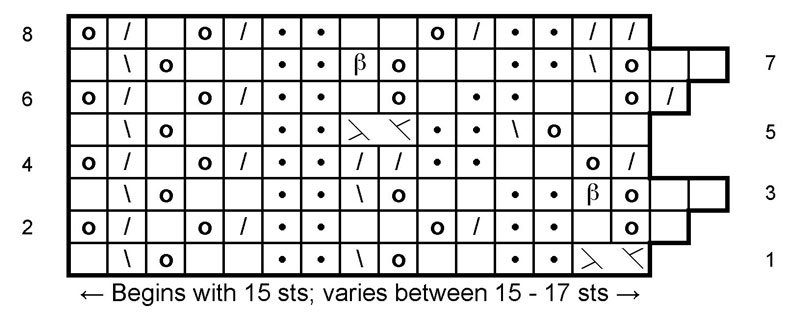
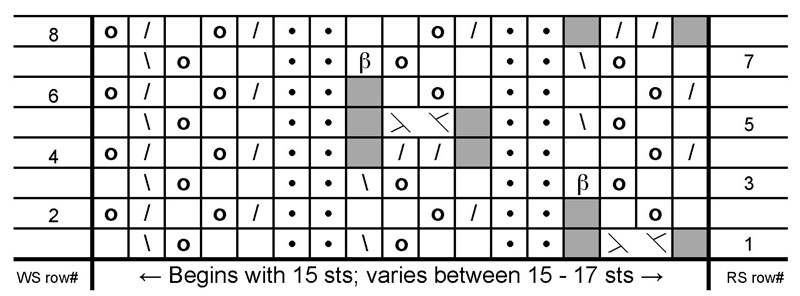
2 different styles of charting the same lace stitch edging

How are you doing with the Lacy Cable Scallop Edging used in this month’s learn-along project for Summer Lace Anklets? If you are using the charted instructions, you are getting more practice using a chart that incorporates the “no stitch” symbol like we introduced in the Lace Cable Bookmark project.

The chart included in the Summer Lace Anklets pattern looks like this:

Chart for Lacy Cable Scallop Edging in the "no stitch" style

Chart for Lacy Cable Scallop Edging in the "no stitch" style

The use of “no stitch” symbols in the chart above helps to preserve the stitch alignment of the p2 columns. However, it is not obvious on this lace edging chart that there is a shaped edge, or whether it is on the left or right edge of the chart. This is because the shaping of the edge is actually done with decreases interior to the pattern stitch.

Here is another style of charting this same Lacy Cable Scallop Edging that clearly indicates which edge of the lace edging is the straight one vs. the shaped one.

Chart for Lacy Cable Scallop Edging in the "shaped edge" style

Chart for Lacy Cable Scallop Edging in the "shaped edge" style

However, because “no stitch” symbols are not used, the stitch alignment of the p2 columns is no longer obvious.

Bottom line — there are trade-offs in each charting style. What is your preference and why?

Posted in Bit-size Tutorials | Tagged , , | 23 Comments

cable-and-lace edging split cuff Summer Lace Anklets

Summer Lace Anklets is the June project pattern for Bits of Lace 2012. Get it free at the Free Membership Pattern page through June 30, 2012 with your active registered membership to KnitHeartStrings.com.

Summer Lace Anklets begin with a piece of lace edging like we did with the Three Eyelets Sachet (i.e. the straight edge of the lace serves as the foundation along which stitches are picked up to continue the project). The pretty cable-and-lace edging transforms into a turn-down split cuff for an anklet sock.

[wp_lightbox_prettyPhoto_image link=”http://www.heartstringsfiberarts.com/images/a85-4025-500.jpg” description=”Summer Lace Anklets”  source=”https://www.knitheartstrings.com/images/postcard-summer-lace-anklets-banner.jpg” title=”Knitting Bits of Lace Series”]

Of course, if socks are not your thing, feel free to use this pretty cable-and-lace edging in other creative ways.

Summer Lace Anklets are designed for cotton and cotton-blend yarns. This makes them nice for summertime and those who prefer cotton. If you prefer to knit with wool, that will work out just fine, too.

For this Bits of Lace 2012 version of Summer Lace Anklets, I have included a chart for the lace edging (in addition to the written instructions that were in the original 2001 edition of the HeartStrings #A85 Summer Lace Anklets pattern).

So, like the Lace Cable Bookmark pattern last month, you can use either the written or charted instructions (or both) for the lace edging. If you are comfortable with charts now, I encourage you to use them. But if you prefer written instructions, or if you  still need more time and practice to get used to charts, feel free to use the written instructions to help ease your way for enjoyable knitting.

Unlike the Lace Cable Bookmark that used lace eyelets to simulate the look of a crossed-stitch cable, the cable-and-lace edging of Summer Lace Anklets actually has crossed stitches. So for those who were asking about cables, here’s your chance to have your lace and do cables, too!

Stay tuned for follow-up tutorials, tips & techniques on this site. And don’t forget to also visit HeartStrings FiberArts for other inspiration and patterns offered by retailers of Jackie E-S’s designs.

p.s. If you’d like to get yarn like I used to to make my own Summer Lace Anklets, I have yarn packs available for sale. Includes your choice of color combo for the main sock color and the lace trim color. If you need help picking colors, let me know.
 

Posted in Bits of Lace | Tagged , , , | 6 Comments

Last day for Lace Cable Bookmark pattern in the Free Membership Area

This is the last day that the Lace Cable Bookmark pattern will be available in the Free Membership Area. I hope you enjoyed making a lace bookmark, and I hope you learned a bit more about lace and charts.

Tomorrow we move on to the next monthly pattern project for Bits of Lace 2012. Stop by then so you can find out what the new month’s project is, get the pattern for free and get started early. More fun and bit-size learnin’ a-comin’!

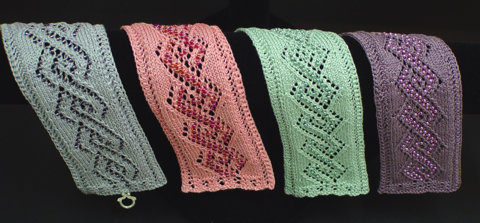
p.s. If you liked this month’s project and like knitting with beads, there are 4 different beaded versions of the Lace Cable design also available for sale as HeartStrings pattern #A94 Beaded Lace Cable Bookmarks and Bracelets.

Beaded Lace Cable Bracelets and Bookmarks

Beaded Lace Cable Bracelets and Bookmarks


Posted in Bits of Lace | Tagged , | 2 Comments

Keeping Your Place in a Chart

There are probably just as many good ways to help keep your place in a chart as there are people here in our group, lol. Just type a search term like “keeping your place in a chart” into Google and you will read lots of suggestions. So I’m not even going to attempt to tell you all the ways because you are likely to already have a foundation for your own preferences. In fact, I am going to ask you later below to help me out  by sharing your own favorite.

For the bit-sized story here, I’m going to just touch on a couple of main points —

We’ve already covered good working conditions for avoiding mistakes. Applying those to our reading of charts goes doubly ditto. Especially the part about good lighting, contrast and magnification if necessary. For example, charts in some publications can be terribly tiny or difficult to read. So, enlarge or re-transcribe them to make it easier to see. Highlight with different colors any symbols that are confusingly similar.

I am partial to using some kind of straight edge to keep my place, whether it is in written instructions or charted. Sometimes I just use a ruler, sometimes a magnet strip on a metal board (like cross stitchers use), and sometimes removable post-it note(s). Some people like to use removable highlighter tape. The idea is that you can use whatever helps you focus on the row you are working.

The main difference I would suggest in keeping your place on a chart (vs. what I do in written instructions) is to put the straight edge focus ABOVE the row you are working on.

I know the logical thing seems to be that you would put the straight edge below (because that is what we’ve usually been taught to do when keeping our place when reading text).  It’s not wrong to do so, but this is where you can really leverage the usefulness of charts being visual representations. So I’d really like you to try the ABOVE method with charts if you haven’t done so before.

The similarity in visual representation of the rows you have already worked on the chart, compared to the knitting hanging below your needle at the place in the row you are now working, will help you keep your place in the chart.

Now it’s your turn. Do you have a favorite bit-sized tip for keeping your place in a chart that you’d like to share? Don’t be shy. There are no wrong answers. Let’s see how many different ones come up!

Posted in Tips & Techniques | Tagged , | 16 Comments

Q&A re. Chain Stitch Selvedge

Although Nellie did not ask a question, I feel there is a question behind her comment to How You Slip Does Matter that I want to address …

Nellie wrote:

I remember when I first started lace knitting and was on a shawl group.
I mentioned that I like knitting the chain edge. I was sharing this with others.
I felt that I was scolded by more experienced lace knitters.
Their opinion was that the chain edge was not suitable for shawls. If I remember correctly, they said something about distorting the edges.

I don’t understand why someone (even a “more experienced” lace knitter) would scold you about your preferences. I am sorry you were subjected to that and hope it does not put you off.

As you can see in the close-up in the photo for Chain Stitch Selvedge of the Lace Cable Bookmark, the chain stitch lays sideways and therefore is not in the same orientation as other stitches. So technically that could be interpreted as distortion. But does not make it inappropriate as such for shawls.

Also, the slipped stitch spans 2 rows. When that stitch has been knitted on the previous row, and now slipped purlwise with yarn in front, the stitch height can expand to the full 2 rows over which it spans. (assuming you are knitting at a loose lace tension rather than snugging up your knitting unnecessarily at the edges!) However, if any one of these elements of the “formula” is not met, you can result in a twisted stitch, or a stitch for which the height is otherwise less than the 2 rows; thus causing the edge to distort because eventually it is shorter than the rest of the knitting.

There are many ways to treat the selvedge stitches of lace edgings, and lace items in general. Some methods are preferred for their function (e.g. stability vs. stretchiness and how they hold up to wear and use). Some are preferred for their aesthetics. Compatibility of both is the balancing act of design. Discerning which we want to use when and where is what helps us increase our skills and makes are knitting distinctive. I will be revisiting and expanding on this in the future.

Posted in Q&A | Leave a comment

The “No Stitch”

An advantage of charted instructions is the visualization of what we actually are knitting. This is where charts can be easier to use than written line-by-line directions. You can see row by row how a pattern is supposed to look (or at least, usually a good approximation).

But there are also limitations to charts. Most notably is the nature of a chart confined to a grid of vertical and horizontal lines. A simple grid is not able to communicate, without some kind of alteration, lace patterns that have differing stitch counts from row to row. And thereby the reason that the “no stitch” might be encountered in charts (whereas you never have a need for it in written instructions).

If the number of stitches varies from row to row, then the charted representation of fewer or more stitches in a row necessitates the need for removing or adding grid cells to that row in the chart. One method is to use the “no stitch” symbol, typically represented by a totally gray or black cell. These “no stitch” symbols are inserted in the chart, if needed, to maintain the correct stitch count, but still allow the chart to look similar to the resulting knitting. Essentially they are just placeholders for grid layout. When knitting the chart, you should ignore them.

Here’s the simple, short message: When reading a chart that has any of these gray or black “no stitch” symbols, you just pretend they are not there. For example, in the chart for Lace Cable Bookmark, you only knit according to the other “real stitch” symbols (i.e. the ones that have a white background).

It’s as easy as that. Please don’t let “no stitch” trip you up or deter you from using charts. I hope this explanation helps if you’ve felt it’s been a mystery before.

Posted in Bit-size Tutorials | Tagged , | 4 Comments