yarn over at beginning of row

The little lace edging used for the Quick Lace-Edged Baby Socks has a picot straight edge that is both pretty and functional. The heading of this lace edging uses a yarn over at beginning of row to form the picot loops. The straight edge remains straight (rather than increasing) because the yarn over is immediately followed by a decrease (in this case, a p2tog).

It is quite common for lace edging patterns to have yarn overs at the beginning of a row, so it is a technique to become comfortable doing.

  • If used on the straight edge, they are primarily functional (where they make a stretchy edge that can easily be sewn to stretchy fabrics like the baby socks).
  • They can also be used on the shaped edge. That was not the case on the little lace edging used for the baby socks, but you’ll be ready for this later on.

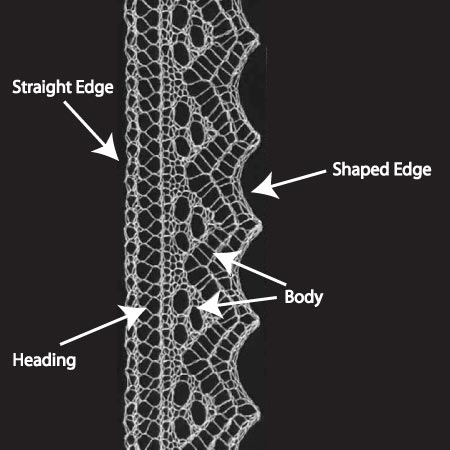
Note: If you need a review of what I mean by heading, straight edge and shaped edge, you can see the schematic of a generic lace edging here.

So let’s get started doing a yarn over at the beginning of a row. It really is quite simple.

1. Start the row with your working yarn held in FRONT of the right-hand needle. Just pretend that your next stitch to be made is going to be a purl stitch (although it might or might not be).

2a. If the first stitch of the row is a KNIT-type stitch (e.g. k2tog or k2togtbl), then you’d just proceed to work the knit-type stitch while keeping the yarn to the front rather than passing it to the back under the right-hand needle. In this case, the yo is automatically formed by the yarn going over the working needle to knit the stitches together.

2b. If the first stitch of the row is a PURL-type stitch such as in the little lace edging pattern for the baby socks (i.e. it is p2tog), then we have a bit of extra work to do than if the next stitch were a knit-type. It’s not much though —

Just wrap the yarn OVER the right needle from front to back and around to the front again. Here is a picture of the loop you will have made.
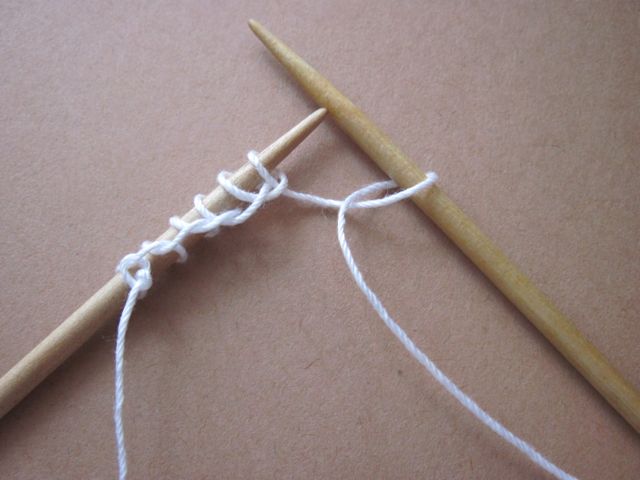
Yarn over at beginning of row (to be followed by a purl-type stitch)

Yarn over at beginning of row (to be followed by a purl-type stitch)

Here are pictures of the sequence of steps in completing the “yo, p2tog” sequence such as used in the baby socks edging:
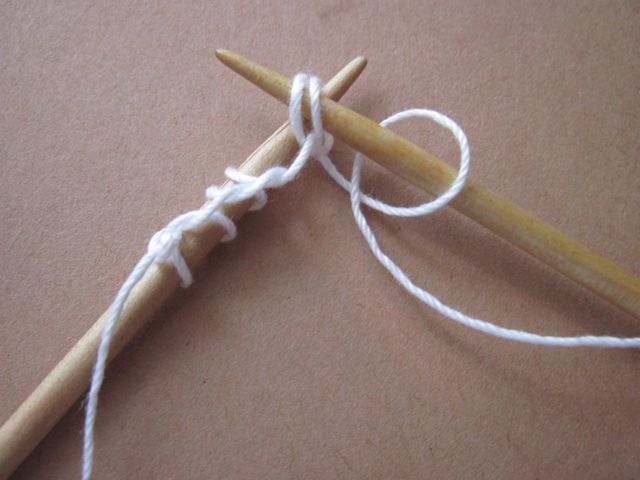
Inserting needle to make the p2tog
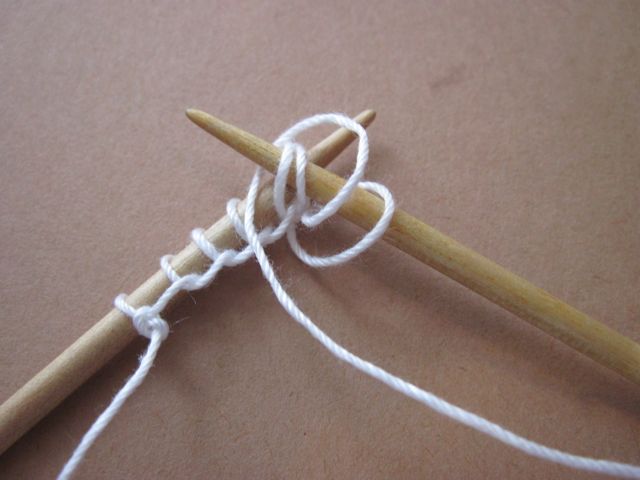
Inserting needle to make the p2tog

wrap (or pick) yarn to make the p2tog in the usual way
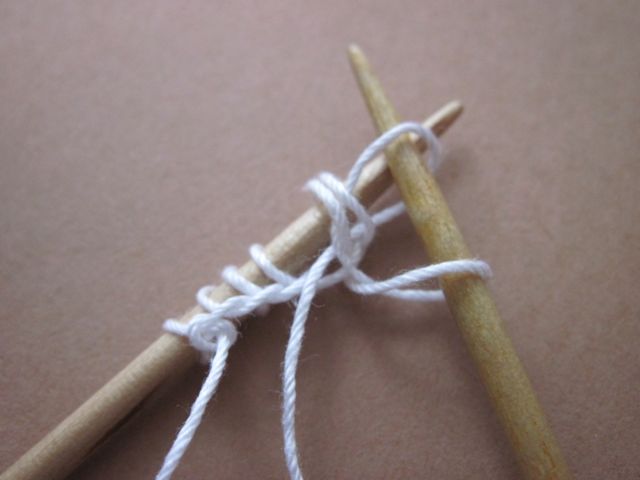
wrap (or pick) yarn to make the p2tog in the usual way

pull yarn through old stitches to make new stitch

pull yarn through old stitches to make new stitch (in addition to the yarn over already made on the right-hand needle)
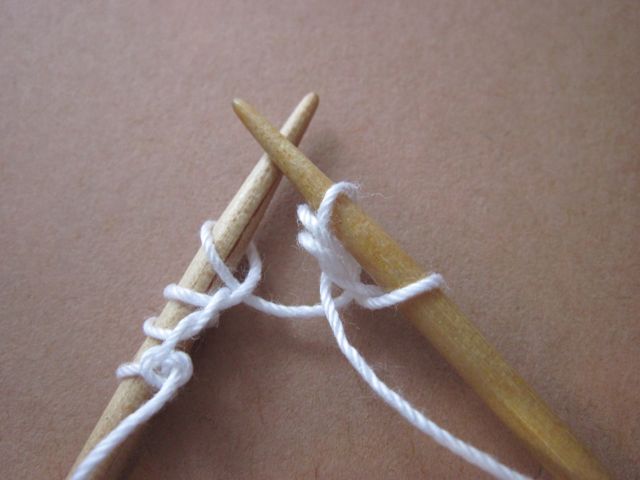
yo and p2tog completed

yo and p2tog completed

As an additional resource, these are links to videos by Lucy Neatby about doing a yarn over before a knit stitch, and another about doing a yarn over before a purl stitch. She describes it a bit differently than I did above (and the sample she is working is not lace edging), but it works out to be the same.

You Tube video by Lucy Neatby: yarn over at start of row before a knit stitch

You Tube video by Lucy Neatby: yarn over at start of row before a purl stitch

I hope that between the still pictures and the motion videos, you’ll understand and enjoy making yarn overs at the beginning of a row when they turn up in the lace patterns you want to make. Let me know if I’ve missed anything about which you are unclear.


Posted in Tips & Techniques | Tagged , , | 3 Comments

Choosing thread / yarn for a lace edging

In this week’s Bit-size Tutorial, I will touch on some things to think about when choosing thread / yarn for a lace edging.

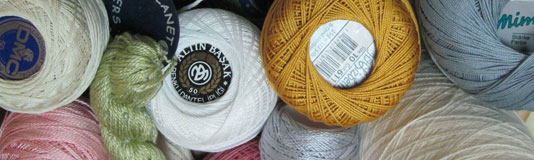
Some possible threads for knitting lace edgings

For simplicity, I am going to just use the term Thread throughout this discussion, but feel free to substitute the term Yarn if you prefer.

General characteristics

  • a smooth thread is usually preferred to show crisp definition of the lace fabric texture
  • a firmly twisted thread holds up better to the wear and tear of handling that edges are apt to get

Thread weight

  • the thread is usually relatively fine to give the lace a dainty look and feel (but don’t limit yourself in trying thicker threads, too)
  • match the relative weight of the lace edging fabric to the weight of the article to which it will be attached
  • does it look balanced?
  • does it feel balanced?

Type of fiber

  • use a thread that is made of fiber that is similar to the article which is to be edged or embellished; e.g. cellulosic (plant) vs. protein (animal)
  • similar elasticity
  • consider use of the item; e.g. if it will need to be washed/cleaned, then thread chosen should have same care instructions as article to which it will be attached

Thread color

  • use of white and natural (unbleached) gives a traditional look
  • choice of color is so personal; therefore, there is no right or wrong
  • coordinate or contrast with article to which the edging will be attached (your choice)

It’s likely that none of these points so far are a surprise to you, but rather it can just be a reminder and convenient checklist. Here is one that might be less obvious …

In fine lace, thread size is less a determinant of gauge than needle size is.

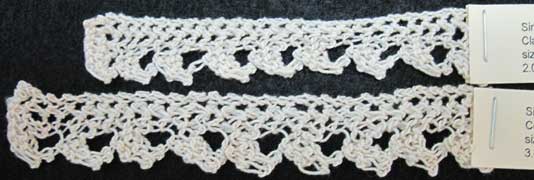
 simple eyelet #2 lace edging

In the above picture, the exact same thread was used (a vintage size 30 Clarks 3-cord mercerized cotton crochet thread from my Grandmother’s stash), same pattern stitch, same number of row repeats, and same knitter (me). The same brand of needles was used and the needles were made of the same type material. The only variable was the size of the needles. The edging sample that resulted smaller was done on size 2 mm needles (US 0); the larger on size 3 mm needles (which are between US size 2 and 3).

Both lace edging samples are attractive, but if I were to have tried only one needle size, I might have dismissed using the thread for one of my projects. Thus, the choice of a thread can go hand in hand with what knitting needles are to be used. This leads into next week’s Bit-Size Tutorial on Knitting Needles.

p.s. The lace edging pattern pictured above is different than the one you have done for the baby socks. Please don’t be confused by that. We’ll get back to this and other more involved lace edgings over the next months.

Posted in Bit-size Tutorials | Tagged , | 3 Comments

Simple Cast On :: a time and place for simplicity

How many of you did the simple half-hitch cast on, as I suggested, for beginning the edging pattern for the baby socks?

To me, the simple half-hitch cast on is one of the simplest methods to use as part of achieving an almost invisible seam in a narrow lace edging like we are doing for the baby socks. And especially for a case like this where a bit of seam line isn’t going to really matter much anyway.

There are methods to produce a totally invisible seam with a combination of provisional cast on and grafting, but they can get quite involved when there is lace patterning (i.e. yarn over’s) on every row as there often is for lace edgings. (that will be covered much later in the year after we get other things under our knitting belts)

Sometimes simplicity with ‘good enough’ results outweighs overkill.

Perhaps you used a different cast on. Maybe you didn’t know how to do a simple half-hitch cast on, … or aren’t quite sure if you did, … or you just wanted to use your own choice of cast on. Whatever you did, it’s fine as long as you are enjoying. I’m never going to be someone who says you have to knit a certain way.

For those who would like to learn (or re-learn) about the simple half-hitch cast on, there is a nice set of pictorial step-by-steps here at the How Stuff Works website. This webpage link will actually bring up a document with several types of cast on’s. They all have their place in knitting, but for now I’d like you to scroll about half-way down to the section called “Simple Cast On (Backward Loop Cast On)”.

I’ve heard this type cast on called other names such as “thumb cast on” and “twisted loop cast on”. There are probably even more I have forgotten! But they all use a single strand of yarn and just one needle to accomplish. For some people, the simple cast on was the first you learned. And then you were advised to never use it again. Too bad. It does have its place in certain situations.

When starting the edging for the baby socks with the simple half-hitch cast on, you should end up with something that looks like this:

[wp_lightbox_prettyPhoto_image link=”https://www.knitheartstrings.com/wp-content/uploads/2012/02/Simple-cast-on-1.jpg” description=”The start of Quick Lace-Edged Baby Socks using the simple half-hitch cast on” source=”https://www.knitheartstrings.com/images/simplecaston.jpg” title=”Simple half-hitch cast on”]

Summary: The simple half-hitch cast has a place in your knitting bag of techniques for projects like the Quick Lace-Edged Baby Socks where you have a narrow lace edging that will be joined with an easy ‘good enough’  almost invisible seam.

p.s. As always, I invite your comments and questions. This is your site, too.


Posted in Tips & Techniques | Tagged , | 7 Comments

Knitted Lace Edgings: a working definition and basic characteristics

I hope you are enjoying the Quick Lace-Edged Baby Socks pattern, the first project in our Bits of Lace 2012 series.

To kick off the extra bonus Bit-sized Tutorials, I’ll begin with the working definition of Knitted Lace Edgings that will serve as the framework for the type of knitting we are focusing on in this series. I’ll also touch on the basic characteristics of Knitted Lace Edgings, but later on in the series I’ll be coming back to each of these in more detail.

There is much to cover and I don’t want to inundate you with information overload. The idea of this is to keep you enjoying your knitting while serving up bit-sized tidbits. The more I learn about the lace, the more I discover there is to learn and explore. I hope you will enjoy the journey with me.

Working Definition of Knitted Lace Edgings
(for purposes of Bits of Lace 2012)

  • Edgings – Something that forms or serves as an edge or border
  • Lace – A fabric structure with planned holes
  • Knitted – Intertwining yarn or thread in a series of connected loops using 2 pointed ‘sticks’  (i.e. I will be keeping the scope of this series to hand knitting)
Basic Anatomy of a Knitted Lace Edging

Basic Anatomy of a Knitted Lace Edging

Basic Characteristics
(typical, but there are exceptions we will play with later in the year)

  • Narrow – Relatively few stitches in a row
  • Dainty – Fine threads and small needles (usually, but not necessarily)
  • One shaped edge – Number of stitches changes from row to row
  • One straight edge – “Heading” pattern selected for function and design

Next up in Bit-size Tutorials: Thread / yarn

I invite you to post comments. If you have questions, that’s fine, too. That way it will be a cross-check for me to make sure I have your answer covered somewhere later in the series.

Posted in Bit-size Tutorials | Tagged , | 7 Comments

Announcing Bit-size Tutorials, Tips & Techniques

As a member of Bits of Lace 2012, the year-long series being hosted at this new Knit HeartStrings membership site, you’ll not only get a free project pattern each month, but also bonus knitting tutorials, tips and techniques.

Later today I will post the first of the Bit-size Tutorials. Then, on each Friday thereafter, my plan is to post the next mini-tutorial. On Saturdays, I will post a tip or technique related to the project pattern we are doing for the month. Watch for these and check them right away to take full advantage of your Free Membership.

Not a member yet? Go to the Registration form here to join now. It’s free, so why wait?

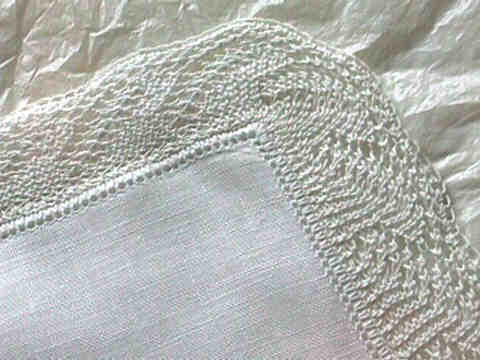
Lace-edged Hanky

Lace-edged Hanky

Posted in Bits of Lace | Tagged , , | 3 Comments

Kicking off “Bits of Lace”

Drum roll … this new Knit HeartStrings membership site is still barebones. But I don’t see any reason to hold off rolling out the first pattern of the 2012 series for Bits of Lace now. I have lots of other features and content planned to add to the site. So I hope you will join in now to start taking advantage of it all.

I’m sending out the announcement tonight to almost 700 members of my HeartStrings newsletter who have already signed up for Bits of Lace.  I would keep my fingers crossed that there are no major hiccups with the new site, but then I wouldn’t be able to knit! Sometimes computers drive me crazy.

I’m planning to have a darling little lace pattern project each month of 2012 that will take only a bit of materials (so it doesn’t put a dent in the pocketbook) and a small amount of time (to better squeeze into our busy lives).

I’ll be posting tips and tricks all along. And it is a chance for all members to join in the conversation by posting comments and photos.  If there is a question, or just want to contribute other ideas and variations you are doing, that is fine, too!

Knitted lace edgings are a beautiful addition to garments, linens, and accessories. Because these trims are typically done on just a few stitches, they are a practical way to explore the structure and techniques of knitted lace. Each project will take just a small amount of materials and time. Enjoy!

[wp_lightbox_prettyPhoto_image link=”http://www.heartstringsfiberarts.com/images/h33-0130-500.jpg” description=”Quick Lace-Edged Baby Socks” source=”http://www.heartstringsfiberarts.com/images/h33-0130-227.jpg” title=”Knitting Bits of Lace Series”]

This month’s free pattern Quick Lace-Edged Baby Socks. Grab it now from the Free Content page after you REGISTER for this site if you have previously done so.  (When registering, for the Email field, you can use the same email address you are using to subscribe to the HeartStrings newsletter – that way you won’t get duplicate email newsletters.) Then Login and you are good to go.

Not subscribed to the HeartStrings newsletter? Go ahead and Register here at this site. Then be sure to activate your newsletter subscription when I send you the confirmation email.

Happy “Bits of Lace” knitting to everyone!


Posted in Bits of Lace | 12 Comments