Playing around with variations of the double yarn over

For most things in knitting, there are several ways to accomplish the same thing, or nearly the same thing with subtle differences. And that certainly is the case when it comes the double yarn over sequence in lace knitting.

Several weeks ago, we covered the simple technique of working k1, p1 into the double yarn over of a previous row (see Distinctive and Decorative – the Double Yarn Over). The k1, p1 sequence is probably the most commonly encountered because it is simple to explain and do (being that it requires no special knowledge of other stitches beside a basic knit and purl stitch). Also, from my trials, it appears to result in the most open and symmetrical of the double yarn over eyelet versions.

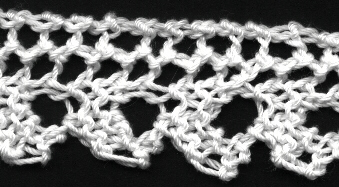
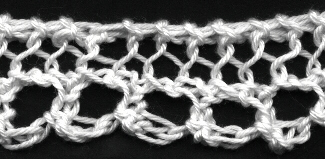
This sequence of k1, p1 will leave a little “dimple” at the top of the resulting eyelet (somewhat like the indention of a heart?). It’s hardly noticeable, but it is there. You can either view it as charming (well, I do love hearts, lol) or you might prefer a different look. That is where I am offering you an opportunity to play around with “nearly the same thing with subtle differences”.

Somewhat fortunately, lace edgings often are designed to be used as a reversible fabric (i.e. garter stitch based). Not always, but it’s quite common. So how you treat the double yarn over on a return row could depend upon whether you are working a stockinette-based lace or garter-based. There are no set rules — mostly it is a matter of design and preferred taste.

Play around with these sequences on the return row of a double yarn over and see which flavor(s) are your preferred:

  • k1, p1
  • p1, k1
  • k1, k1tbl
  • k1tbl, k1tbl
  • p1, p1tbl
  • k1, p1tbl
  • others you can devise?

Note: k1tbl = k1 stitch through back loop; p1tbl = p1 stitch through back loop

In a comment on April 1, Mary Beth offered:

When knitting back the double yarn over, I tend to K the first YO and Ktbl in the second. It leaves a simple (cleaner?) line and I can do it faster than K-P.

I do think the k1, k1tbl does give a somewhat cleaner line on the top of the eyelet of the side facing you as you work that row (which in many lace patterns with a definite RS and WS, that return row will be a WS row). Do be aware of what the reverse side looks like, too, as in many lace patterns that is going to be the more commonly viewed RS.

A subtle difference I notice when doing a k1, k1tbl sequence, is that the  twisted leg of the k1tbl stitch sort of pulls toward the center of the eyelet, therefore making that side of the eyelet a little less open and somewhat asymmetrical. However, if you prefer a method because it is faster and more enjoyable, that can have a lot going for it. After all, knitting should be fun and most people are not going to be looking at each strand of the knitting with a magnifying glass, anyway.

So, are you up to the fun of trying out some of these variations? I’ve given you some of my ideas. Please chime in with your favorite (or favorites) like Mary Beth has. Remember, there is no right or wrong. And you might even point out something the rest of us had not even noticed or considered before.


Posted in Tips & Techniques | Leave a comment

Striving for Perfect Results – Part 2

In Part 1 of Striving for Perfect Results, we covered some tips on PREVENTING mistakes (or at least minimize the chances of them happening).

With all my best attempts at preventing mistakes, I am only human. The reality of life is that lace knitting mistakes will happen. Believe me, I’ve had a lot of practice in getting out of jams I put myself into (and still do!). So in Part 2, I am going to share with you a quick look at my arsenal of tips for REMEDY; i.e. correcting, repairing and recovering. I want you to know that it’s possible to deal with mistakes and survive to tell about it, lol.

Getting Back on Track
(or what to do when inevitable mistakes happen)

  • Take a breath, stay calm
  • Common mistakes and easy remedies

Problem: You have counted the row you just completed and find your stitch count is LESS than it should be because you are missing a yarn over.

Remedy:
Step 1. identify where the yarn over should have been and mark that position

Step 2. as you work the return row, when you come to that position, just pick up the running thread in the row below and place the picked up loop on your left-hand needle
(the picked up loop will be a bit tighter than if the yarn over had been made correctly on the original row, but the bit of difference in tension will not be noticeable after the lace has been washed and blocked)

Step 3. continue on with the return row, working the picked up loop as the regular yarn over stitch that it should have been

Problem: You have counted the row you just completed and find your stitch count is MORE than it should be because you have an extra yarn over

Remedy:
Step 1. identify the extra yarn over stitch and mark that position

Step 2. as you work the return row, when you come to that position, just drop the loop of the extra yarn over off the left-hand needle
(the area where the extra yarn over was dropped off the needle will looser be than if you had not made the mistake, but the bit of difference in tension will hardly be noticeable after the lace has been washed and blocked)

Step 3. continue on with the return row as usual

  • The current row is “off” (not enough stitches to complete row; too many …; pattern design is off …)

Step 1: TINK (knit spelled backwards) – i.e. unwork stitches one by one across the row

Step 2: Recheck your stitch count, then proceed

  • Pattern is just “not working out” and you can’t figure out why

With narrow lace edgings with relatively few stitches like we’ve been doing, if you have barely gotten much done anyway (e.g. still just working on the  first 2 or 3 inches), it’s usually easiest and quickest to just start over rather than stress out trying to find a problem originating multiple rows back. Give it a go again, because maybe you just overlooked or misread something the first time around. (Also see Have Our Eyes Fooled Us.)

  • Anticipate calamities (e.g. dropped stitches)

On the other hand, if you are well into already having worked quite a length of lace edging, you certainly don’t want to rip and start over! That is where using a lifeline can be invaluable. It is like “Insurance for Knitters” comes in.

In short, I’ll include the basic steps below. But there is also a longer tutorial for The Lifeline available on my HeartStringsFiberArts.com website that can be helpful for working with any of your lace projects. 

Inserting a lifeline

Inserting a lifeline

Lifeline Preparation step: Insert a piece of contrasting thread through the stitches of a designated row, e.g. last row of pattern repeat. You will remove these contrast threads after your article is completed.

If/when a mistake shows up —

Step 1: Remove needle and rip back to contrasting thread

Step 2: Insert needle through loop of each stitch (just follow the thread so that the stitches are mounted properly)

Step 3: Recheck your stitch count, then proceed with appropriate row e.g. first row of pattern repeat


Posted in Tips & Techniques | 6 Comments

Striving for Perfect Results – Part 1

Are you a product or process knitter? I bet that most (all?) of us are some of both.

Our Goals

A pleasing result (product) — A satisfying knitting experience (process)

 Use magnification if necessary when knitting lace

To achieve these goals, here is a quick list of some tips to keep in mind.

Getting up to speed

  • Try least complicated instructions first — HAVE FUN!
    e.g. narrow edgings (like we have started out with)
    e.g. alternate rows are (mostly) plain knit or purl
  • Use a heavier thread and larger needles first for practice and to see what is happening

Avoiding mistakes

As we start to get into lace edgings with more stitches and rows per repeat, it helps to keep in mind some things that can help us prevent mistakes (or at least minimize the chances of them happening).

  • Enlarge or re-write instructions, if necessary, so they are easy to see/understand in terminology that is familiar to you
    e.g. write out row-by-row instructions on flippable index cards
    e.g. if using charts (we will cover these later), enlarge charts or re-write in symbols familiar to you
  • Use methods like stickies, checkmarks, row counters, magnetic strips or highlighter to help keep your place
  • VERY important! good working conditions
    e.g. good lighting and contrast
    e.g. magnification if necessary
    e.g. minimal distractions
    e.g. avoid knitting when you are tired
  • Check your work often
    e.g. count stitches after completing row (easier to correct sooner than later — we will talk more about remedying mistakes if they happen in Part 2)
    e.g. visually check your knitting for reasonability

Do you have questions on any of this or need me to expand on any of the points? Much of this is applicable to knitting in general, so I expect that most is not new. But I feel it is important enough to at least mention the key points.

If there are any questions or you need me to expand on any of the points, just let me know. I don’t want to get side-tracked or bogged down in too much detail that is not needed by anyone, but on the other hand, I want to make sure you are getting the help you need to get a satisfying knitting experience and a pleasing result.

Posted in Tips & Techniques | Tagged | 7 Comments

The heritage of white lace

In last month’s bit-sized tutorial on Choosing Thread / Yarn for a Lace Edging, I briefly   touched on using white or choice of color. I do not limit myself to only using white or natural (unbleached), nor would I expect you to. But historically, there do seem to be some definite opinions.

Lace Edging

Traditional white lace

On one end of the spectrum of opinion, white (or at least inconspicuous color) is considered desirable and maybe even mandatory. From the First Book of Modern Lace Knitting, Marianne Kinzel, ISBN 0-486-22904-1, page 16:

Do not use … conspicuous colour, as this is not in the lace-making tradition.

And on the other end of the spectrum, it also has a history of being undesirable, an indication of poverty and inferior quality. From The Complete Book of Traditional Scandinavian Knitting, Sheila McGregor, ISBN 0-312-15638-3, pages 83 and 56:

…lace-knitting was taught in the nineteenth century, but white knitting was never part of traditional knitting in Denmark. Indeed, it plays no great part in Scandinavian folk knitting at all, although simple hole patterns are found, and white gloves and white stockings are worn here and there, particularly on Sundays. By and large, white was never a desirable color in folk knitting and Denmark was no exception.

…white wool was never used where it showed … that would have been a shameful dreadful admission of poverty and lack of skill …

In many of the samples I’ve shown so far, they are done in white or natural color. But there have already been several examples of color. For example, last month’s Lace Bug Bookmark project shown in pink. The Bead-Pinned Lace Edging Ornament which was made with holiday red. And of course, this month’s project Three Eyelets Sachet in French blue.

What do you think about using white vs. color for lace? What color(s) have you been using so far? Do you have a favorite? Let’s get the discussion going and share our thoughts! (I don’t want to be the only one talking here, lol.)

Posted in Bit-size Tutorials | Tagged , | 21 Comments

Three Eyelets Sachet :: little lace-edged knitted pouch

Grab this month’s free pdf download pattern for Three Eyelets Sachet now through April 27, 2012 at the Free Membership Pattern page.

Knit this little sachet bag that starts with an easy 8-row lace edging. Filled with your favorite potpourri scents, it will make a delightful addition to your lingerie drawer or sweater shelf.

[wp_lightbox_prettyPhoto_image link=”https://www.knitheartstrings.com/images/b3f-600×450.jpg” description=”Three Eyelets Sachet” source=”https://www.knitheartstrings.com/images/postcard-sachet-banner.jpg” title=”Knitting Bits of Lace Series”]

Stay tuned for follow-up tutorials, tips & techniques on this site. And don’t forget to also visit  HeartStrings FiberArts for other inspiration and patterns offered by retailers of Jackie E-S’s designs.

Posted in Bits of Lace | Tagged , , , | 1 Comment

Bead-pinned Lace Edging Ornament

Have you started playing with Simple Eyelet #2? I bet some of you are hesitant to start trying it out because you are trying to decide what you might use your bit of lace for. Besides the ideas already presented in the monthly projects, here’s another to go along with our bonus weekend.

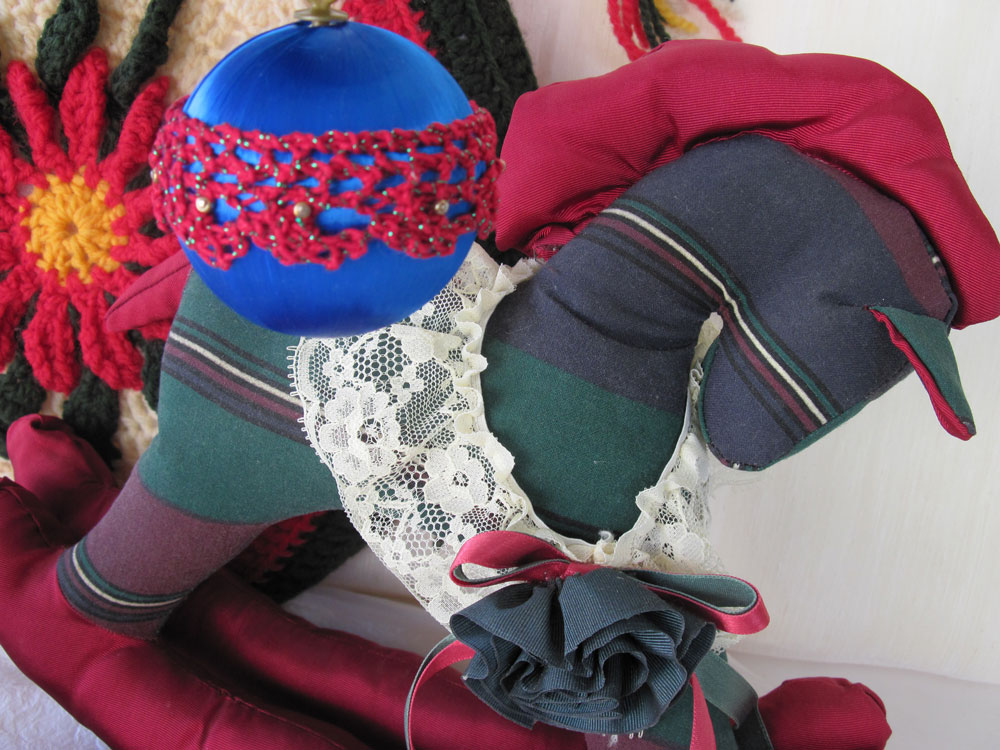
Usually we think of attaching lace to some other textile item. However, this little adornment is just a commercially available satin-covered styrofoam ornament trimmed with a short length of the Simple Eyelet #2 lace edging. Even a plain styrofoam ball makes a nice ornament when dressed up with festive lace edging.

Lace edging trimmed ornament

Lace edging trimmed ornament

For example, if you use a 3″ diameter ball (the most common size usually available in the holiday or party decoration stores), you’ll need a 7.5″ length of lace edging after blocking and lightly stretched. You don’t really need to measure; just check if you have made your lace edging long enough yet by temporarily wrapping it around the ball while stretching slightly as you do so. Then complete the Simple Eyelet #2 repeat through row 5, bind off and sew the 2 ends together.

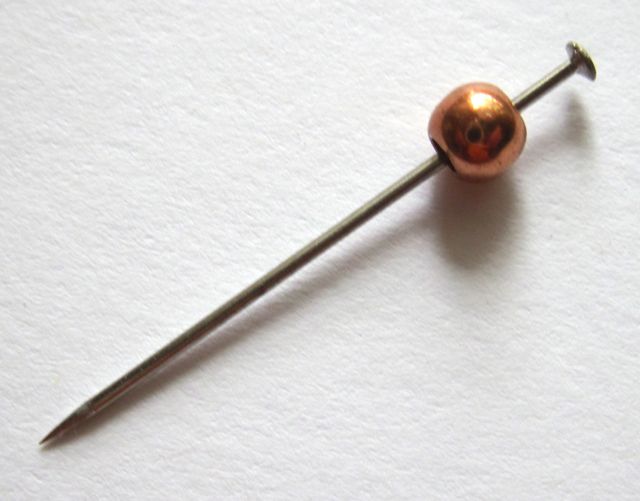
Here’s a simple technique tip for attaching the lace edging to the styrofoam ball.  The technique is both easy and decorative: Insert a sewing pin through a bead (with a bead hole that is small enough so that the head of the sewing pin is caught), then push the pin through a firm area of the lace into the styrofoam.

Push a sewing pin through the hole of a bead

Push a sewing pin through the hole of a bead

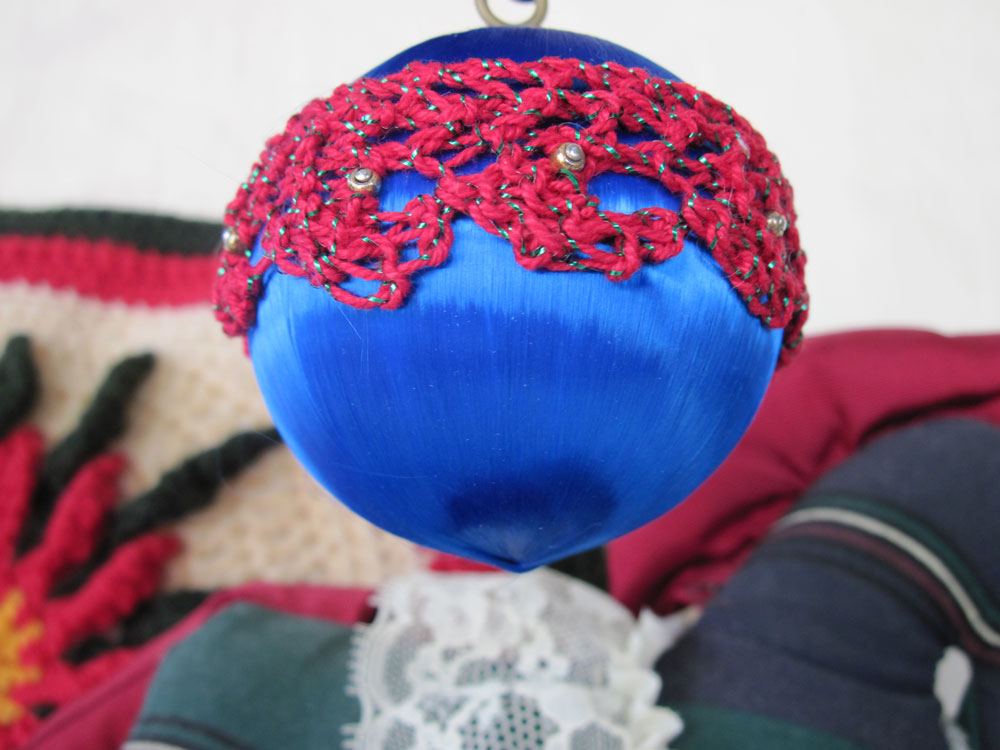
Insert a bead-pin every so often (for example in each repeat of the edging), all around the circumference of the ornament. You can use the photo here as a guide.

Space the bead-pins at each repeat of the lace edging

Space the bead-pins at each repeat of the lace edging

So what ideas do your have for your Simple Edging #2? Have fun!

Posted in Tips & Techniques | Tagged , , , , | 8 Comments

Simple Eyelet #2

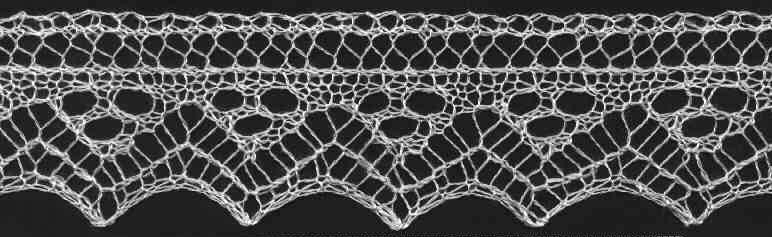
I haven’t really come across consistent, standardized names for most lace edging patterns. In fact, many references just assign a number in the publication. If needed, I usually just give them a nickname based on what they look like to me. For example, for this little edging, I simply refer to it as Simple Eyelet #2 because of the single eyelet which is its distinctive feature. As a bonus this month for you, I’ve included the instructions later in this bit-size tutorial.

Simple Eyelet #2

Simple Eyelet #2

You might remember seeing Simple Eyelet #2 a few weeks ago when I was discussing knitting needles (I just didn’t mention a name for it at that time, because I didn’t want to get ahead of myself). 3 points about knitting needles to make lace edging

At that time, I was showing you this lace edging as an example of using a different needle size, while using same thread, same edging pattern, same number of repeats. Here’s your chance to “play” with different needle sizes, too!

Compare the look of Simple Eyelet #2 to the lace edging used in the Lace Bug Bookmark pattern. You probably already guessed why I would nickname that Simple Eyelet #1.


Simple Eyelet #1

Simple Eyelet #1

Even though there are similarities in looks, there are differences in stitch sequences used to produce the eyelet itself, subtle differences in the selvedges along the straight and shaped edges, and the faggot heading is different, too. Not to mention that there is more “fabric” in Simple Eyelet #2, giving it a heavier/denser or more substantial look. I’ll expand on these differences in future discussions, but meantime I want you to give this pattern a try and see if you can spot them yourself.

Simple Eyelet #2

Cast on 5 sts.

Row 1: k1, yo, p2tog, k1, yo, k1. (6 sts)

Row 2: k1, k1 and p1 and k1 all into the yo of previous row, k1, yo, p2tog, k1. (8 sts)

Row 3: k1, yo, p2tog, k5.

Row 4: k5, yo, p2tog, k1.

Row 5: repeat row 3.

Row 6: bind off 3 sts, k1, yo, p2tog, k1. (5 sts)

Repeat rows 1 – 6 to nearly length desired, then works rows 1 – 5 once more. Bind off all sts loosely.

~~~~~~~~

Enjoy this bonus lace edging pattern to practice with and use in any way you want. I’d love to hear what you think about it and see what you do with it.

p.s. Did you remember about the Curved Edge Bind Off technique?

Posted in Bit-size Tutorials | Tagged , | 1 Comment